
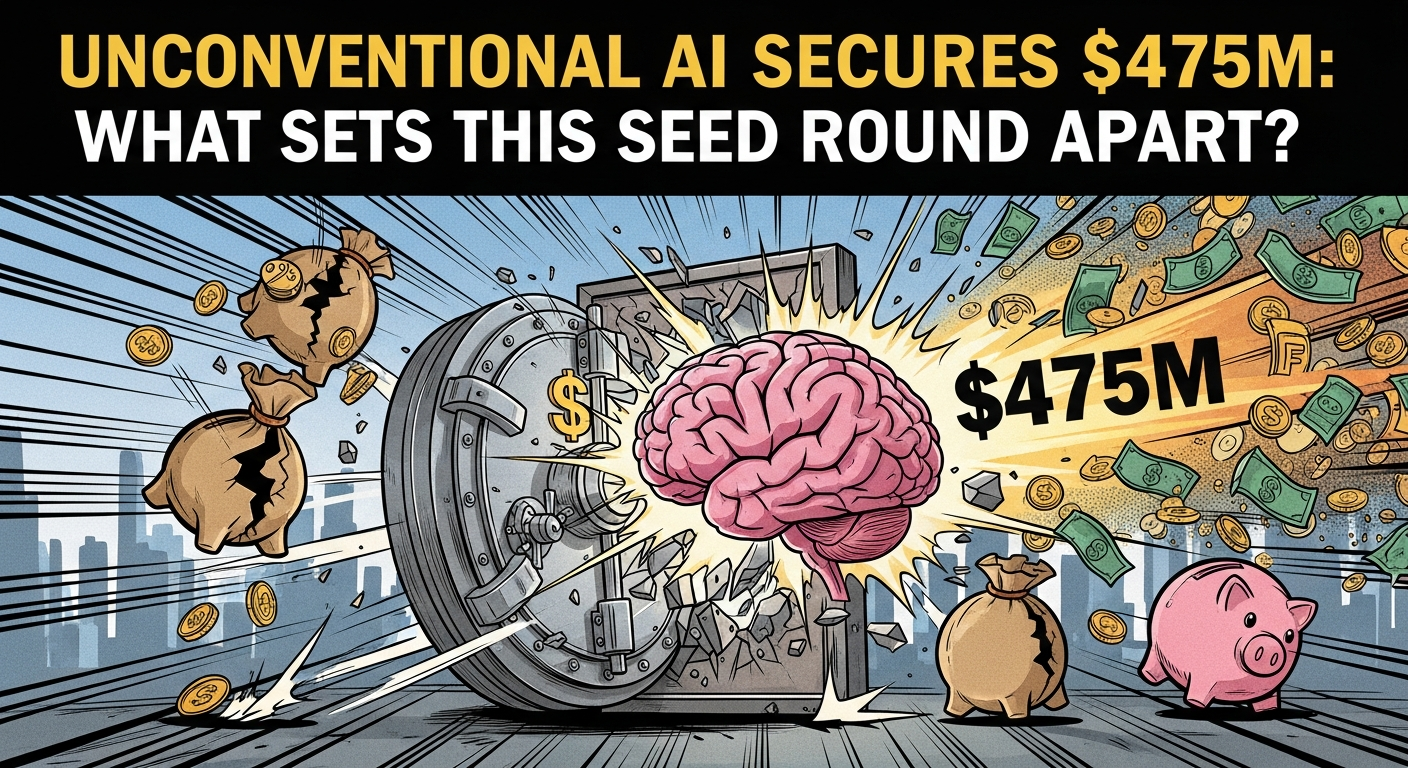
In a significant development for artificial intelligence infrastructure, Naveen Rao has attracted substantial investment for his latest venture aimed at revolutionizing AI computing architecture. The former Databricks AI chief has secured an impressive $475 million seed funding for Unconventional AI, with the company already valued at $4.5 billion before launching a product. This financing round represents one of the largest seed investments in AI hardware history and signals strong investor confidence in Rao’s vision for more efficient AI computing systems.
Massive Seed Funding Backed by Top Venture Firms
Unconventional AI’s initial funding comes from some of technology’s most prominent investors. Andreessen Horowitz and Lightspeed Ventures led the round, with Lux Capital and DCVC also participating. According to Rao’s statements to Bloomberg, this $475 million represents just the first installment toward a potential $1 billion funding goal for the round. The current valuation, while slightly below the initially reported $5 billion target, still places Unconventional AI among the most highly valued pre-product startups in the AI sector.
The scale of this investment reflects growing recognition that AI infrastructure represents a critical bottleneck in advancing artificial intelligence capabilities. As large language models and other AI systems continue to grow in size and complexity, the energy and computational requirements have increased exponentially, creating both technical and environmental challenges for the industry.
Mission to Build Biology-Inspired Computing
At the core of Unconventional AI’s mission is the development of a new type of energy-efficient computer specifically designed for artificial intelligence workloads. Rao has previously shared on social media that his ambition is to create computing systems that approach the efficiency of biological systems. This vision suggests a fundamental rethinking of how AI hardware processes information, potentially drawing inspiration from how the human brain operates with remarkably low energy consumption compared to current AI systems.
The energy efficiency challenge has become increasingly critical as AI models grow larger. For context, training modern large language models like GPT-4 can consume energy equivalent to hundreds of households’ annual usage, creating both cost and environmental concerns. By developing hardware that processes AI workloads more efficiently, Unconventional AI aims to address one of the most pressing limitations in advancing artificial intelligence capabilities.
Rao’s Proven Track Record in AI Startups
Investors’ willingness to place such a substantial bet on Unconventional AI stems largely from Naveen Rao’s impressive history of successful AI ventures. In 2023, Databricks acquired his previous startup, MosaicML, for $1.3 billion. MosaicML had developed tools to make training large language models more efficient and cost-effective, addressing similar challenges from the software side that Unconventional AI now aims to tackle through hardware innovation.
Prior to MosaicML, Rao co-founded Nervana Systems, a machine learning platform that Intel acquired in 2016 for reportedly over $400 million. This pattern of successfully building and exiting AI companies has established Rao as one of the field’s most accomplished entrepreneurs, particularly in addressing the infrastructure challenges of artificial intelligence deployment.
The Growing AI Infrastructure Market
Unconventional AI enters a rapidly expanding market for specialized AI computing infrastructure. The current AI hardware landscape is dominated by NVIDIA’s GPUs, which have become the standard for training and running large AI models. However, their high cost, energy consumption, and supply constraints have created opportunities for alternative approaches.
Several other startups and established companies are also working on specialized AI chips, including Cerebras, SambaNova, and Graphcore, alongside efforts from tech giants like Google (with its TPU architecture) and Amazon (with its Trainium and Inferentia chips). What potentially distinguishes Unconventional AI is Rao’s biology-inspired approach and the exceptional level of initial funding, which provides resources for fundamental innovation rather than incremental improvements.
Implications for the AI Industry
If successful, Unconventional AI’s technology could significantly reduce the cost and environmental impact of developing and deploying advanced AI systems. Current limitations in computing infrastructure have created a situation where only the largest technology companies can afford to build and train cutting-edge AI models, potentially concentrating AI capabilities among a small number of corporations.
More efficient AI hardware could democratize access to advanced AI capabilities by reducing the resource requirements, enabling smaller organizations, research institutions, and startups to develop competitive AI systems. This could accelerate innovation across the field and potentially lead to more diverse applications of artificial intelligence technology.
The substantial investment in Unconventional AI also signals that venture capital remains highly interested in funding fundamental AI infrastructure, despite recent concerns about an AI investment bubble. Investors appear to recognize that while many AI applications may face challenges in finding sustainable business models, the underlying infrastructure represents a critical and potentially lucrative opportunity.
Challenges and Future Outlook
Despite the impressive funding and leadership credentials, Unconventional AI faces significant challenges. Developing novel computing architectures requires overcoming substantial technical hurdles, from chip design and manufacturing to creating software ecosystems that can effectively utilize new hardware. The history of computing is littered with promising alternative architectures that failed to gain traction against established platforms.
Additionally, the company will need to navigate a competitive landscape that includes both well-funded startups and tech giants with vast resources. NVIDIA’s dominant position in AI computing wasn’t achieved overnight, and the company continues to innovate rapidly to maintain its leadership.
Nevertheless, the scale of investment suggests that Unconventional AI has presented a compelling technical vision to its backers. If Rao succeeds in raising the full $1 billion he’s targeting, the company would have resources comparable to established semiconductor companies, potentially enabling truly transformative research and development.
Conclusion
Unconventional AI’s massive seed funding represents a significant vote of confidence in both Naveen Rao’s vision and the critical importance of addressing energy efficiency in AI computing. As artificial intelligence continues to transform industries and society, the underlying infrastructure that powers these systems becomes increasingly important. By focusing on creating more efficient computing architectures inspired by biological systems, Unconventional AI aims to solve one of the fundamental challenges facing the advancement of artificial intelligence.
The company’s progress will be closely watched not only by the tech industry but also by those concerned with the environmental impact of AI and the broader implications of more accessible advanced AI capabilities. With $475 million in initial funding and potentially more to come, Unconventional AI has the resources to pursue ambitious innovation in an area that could shape the future of computing and artificial intelligence.