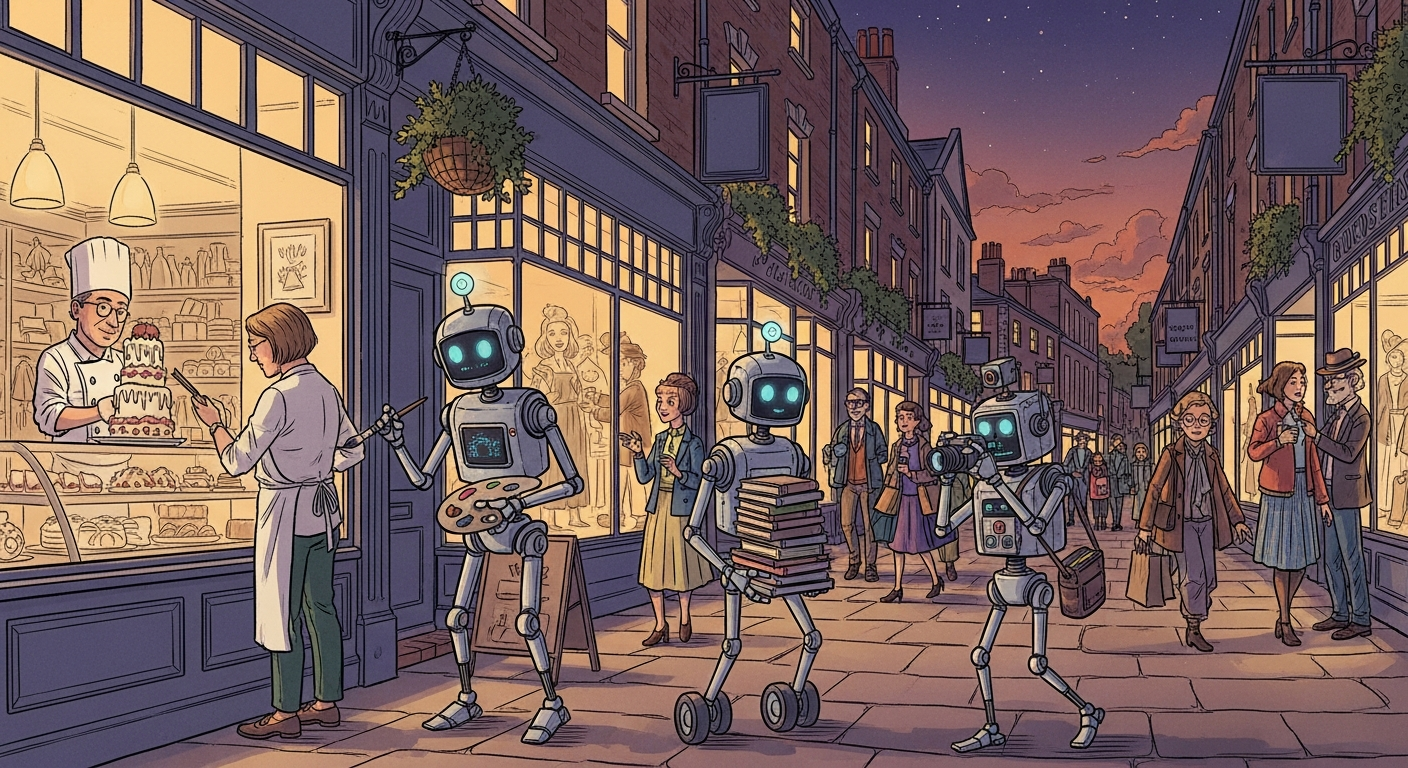
On a quiet street in Portland, Maine, Eliza Woodward’s small bookstore was struggling against the tide of e-commerce giants. Her salvation came not from slashing prices or extending hours, but from an unlikely alliance with artificial intelligence. A custom AI application now analyzes her customers’ purchasing patterns, neighborhood demographics, and even local weather forecasts to suggest optimal inventory and display arrangements. Last quarter, her revenue increased by 23 percent. ‘I was skeptical at first,’ Woodward admits. ‘I thought AI was just for the Amazons of the world. Now it feels like having a business partner who never sleeps.’
While much of the public discourse around artificial intelligence focuses on chatbots and customer service automation, a quiet revolution is unfolding in America’s small business landscape. Local retailers—from boutique clothing stores to neighborhood hardware shops—are discovering that AI offers far more creative possibilities than merely answering customer queries. These advanced tools, once the exclusive domain of tech giants and multinational corporations, are becoming increasingly accessible to small business owners willing to experiment.
The Democratization of AI for Main Street
The notion that artificial intelligence requires millions in investment and a team of Stanford PhDs is rapidly becoming outdated. ‘We’re witnessing the democratization of AI technologies,’ explains Dr. Maya Krishnan, who studies the economic impact of technology at the University of Michigan. ‘What required custom development three years ago is now available as affordable software-as-a-service products specifically designed for small retailers.’
This accessibility has sparked a wave of experimentation among forward-thinking local businesses. In Chicago, a family-owned grocery store uses computer vision technology to monitor produce freshness and optimize restocking schedules. In Austin, a vintage clothing retailer employs AI to search social media for emerging fashion trends specific to their local demographic. These applications extend far beyond the customer-facing chatbots that have dominated popular understanding of AI in retail.
The most successful small business AI strategies share a common approach: they identify specific operational challenges unique to local retail and deploy targeted solutions. Rather than attempting to replicate the vast data operations of national chains, they leverage their intimate knowledge of local markets—something algorithms alone cannot replicate.
Hyper-Local Intelligence: The Small Retailer’s Advantage
Paradoxically, the most effective AI applications for local retailers often capitalize on their smallness rather than attempting to simulate scale. ‘Large retailers use AI to approximate the personalization that small businesses naturally provide,’ notes retail technology consultant Sanjay Mehta. ‘Local shops can use AI to enhance their already deep understanding of their communities.’
Consider Riverbank Hardware in suburban Philadelphia, where owner James Chen deployed a relatively simple machine learning algorithm that correlates local building permits with inventory needs. When a cluster of kitchen renovation permits appears in a nearby neighborhood, the system automatically suggests adjusting stock levels for related items. ‘It’s like having a crystal ball,’ Chen says. ‘We’re ready with the right inventory before customers even know they need it.’
This hyper-local approach represents a fundamental shift in how small businesses approach technology adoption. Rather than viewing AI as a replacement for human intuition, successful retailers treat it as an amplifier of their existing community knowledge. The algorithm doesn’t replace Chen’s decades of experience—it extends it, allowing patterns to emerge from data that would otherwise remain invisible.
Beyond Prediction: AI as a Creative Partner
Perhaps the most intriguing development is how some retailers are using AI not just as analytical tools but as creative collaborators. At Meridian Gifts in Savannah, Georgia, owner Tasha Williams uses generative AI to design custom product collections based on local events and seasonal changes. ‘Last fall, we created a whole line of products inspired by AI-generated designs that incorporated elements of our city’s architecture with autumn colors,’ Williams explains. ‘They sold out in weeks.’
This application points to a future where AI serves not merely as a business intelligence tool but as a creative partner. Small retailers, often operating with limited design and marketing resources, can leverage these technologies to compete with the aesthetic appeal of larger brands. A boutique in Seattle now uses AI to generate window display concepts that change weekly, creating the kind of visual freshness that keeps customers returning.
The creative applications extend to marketing as well. Advanced language models allow small businesses to produce content tailored to highly specific customer segments. Rather than generic promotional materials, these retailers can generate dozens of variations of marketing messages, each precisely calibrated for different customer profiles.
The Human-AI Retail Ecosystem
The most successful implementations share a common philosophy: they view AI not as a replacement for human judgment but as a tool that frees humans to focus on what they do best—building relationships and exercising creativity. ‘The small retailers thriving with AI aren’t using it to reduce headcount,’ observes Dr. Krishnan. ‘They’re using it to make their existing teams more effective.’
This approach creates what some experts call a ‘human-AI ecosystem’ where technology handles pattern recognition, prediction, and routine decision-making, while humans focus on customer interaction, community building, and strategic thinking. The result is not the sterile, automated shopping experience many feared AI would bring, but rather a more responsive, personalized retail environment.
As these technologies mature and become even more accessible, the competitive landscape for local retail may undergo a significant shift. The divide may no longer be between small and large retailers, but between those who thoughtfully integrate AI into their operations and those who remain hesitant. For small business owners willing to experiment with these advanced strategies, artificial intelligence offers not just survival tools but the potential for a renaissance in local retail—one algorithm at a time.