
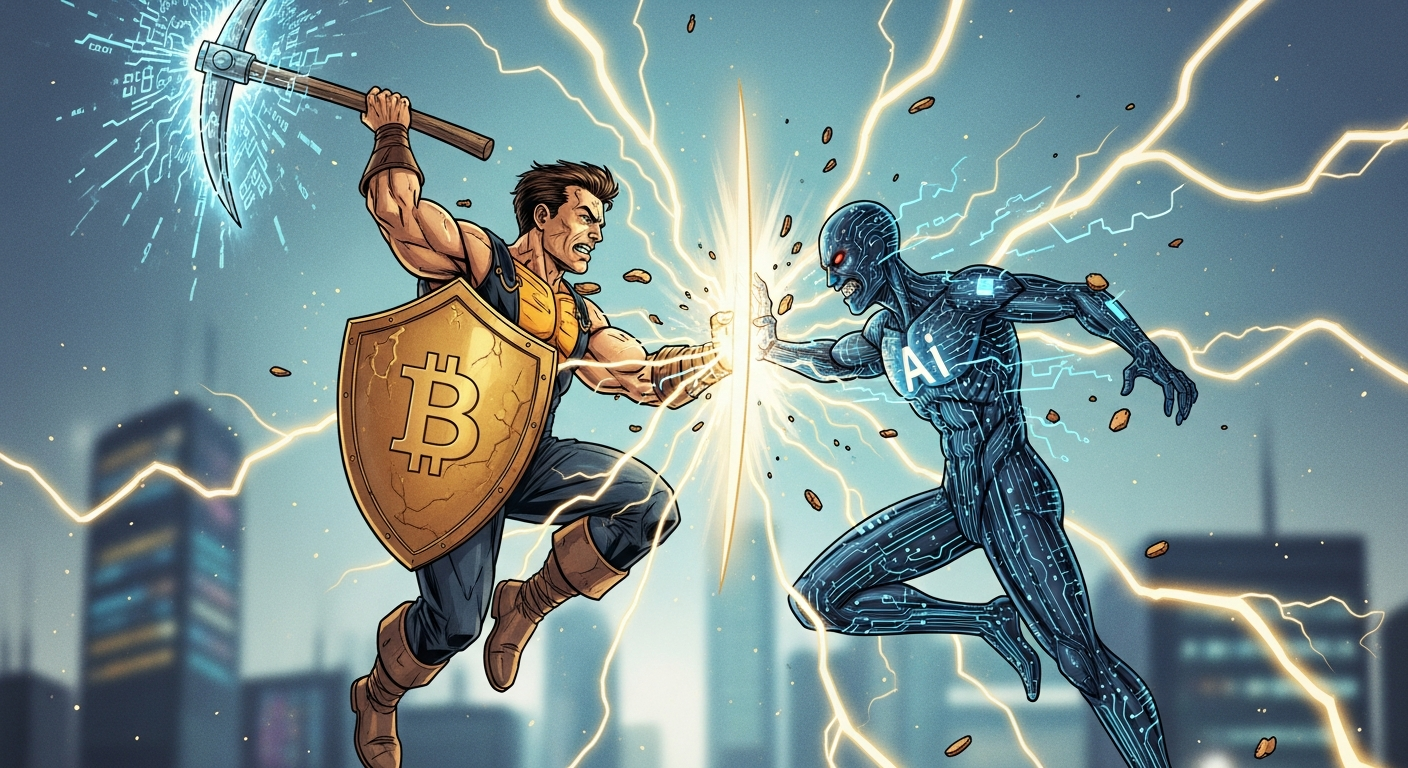
In mid-2024, the landscape outside Corsicana, Texas revealed a telling transformation. Riot Platforms’ massive facility, initially constructed as the world’s largest bitcoin mine, was undergoing a significant pivot. Today, approximately two-thirds of this industrial complex is being converted to support artificial intelligence and high-performance computing (HPC) operations. This transformation from cryptocurrency temple to AI megafactory represents a broader trend sweeping across the bitcoin mining industry.
The Bitcoin-to-AI Migration Wave
Over the past 18 months, at least nine major publicly traded bitcoin mining companies have announced partial or complete transitions toward AI infrastructure. Bitfarms, Core Scientific, Riot, IREN, TeraWulf, CleanSpark, Bit Digital, MARA Holdings, and Cipher Mining are all redirecting their substantial data center investments away from cryptocurrency and toward artificial intelligence.
This strategic pivot stems from intense demand for specialized computing facilities capable of handling AI’s energy-intensive workloads. Ironically, the same bitcoin mining companies that helped build the foundation for today’s AI boom through massive infrastructure investments now find themselves reinventing their business models to survive.
As Meltem Demirors, general partner at Crucible Capital, explains: “Bitcoin mining created the blueprint for the AI compute boom and the modern data center. These companies discovered their cost of capital decreases significantly when they adopt the AI narrative. They already have the powered shells—they’re simply removing mining equipment and letting AI tenants bring in GPUs.”
Economic Forces Driving the Transformation
Several factors have converged to create challenging conditions for bitcoin mining profitability. First, competition on the bitcoin network has escalated exponentially as hardware advanced, requiring ever-increasing computational power to secure mining rewards. Second, 2024 saw the scheduled halving of bitcoin rewards to 3.125 BTC per block. Finally, bitcoin’s price retreat to around $85,000—down 30% from its 2025 peak—created the perfect storm threatening profitability for all but the most efficient operations.
“The economics are terrible today,” observes Charles Chong, VP of strategy at BlockSpaceForce and former strategy director at Foundry. “Purchasing a bitcoin mining machine now offers uncertain return on investment.” Research from CoinShares indicates that by mid-November, only a small fraction of the largest publicly traded mining companies could maintain profitability at current bitcoin prices.
In stark contrast, the AI sector promises better margins and predictable revenue through multi-year contracts with major technology firms. Recent months have seen former bitcoin mining companies announce over $43 billion in AI and HPC contracts, according to CoinShares analysis.
Ben Gagnon, CEO of Bitfarms, which plans to complete its transition to AI and HPC by 2027, maintains that “Bitcoin mining is still profitable. The issue is that HPC creates substantially more value per energy unit, and does so predictably for years ahead, making further investment in bitcoin mining unjustifiable.”
Market Rewards for Strategic Pivots
Financial markets have enthusiastically rewarded mining companies making the AI transition. Stock prices have surged following announcements of partnerships with tech giants like Amazon, Microsoft, and Google, which have signed multi-billion dollar hosting agreements with former pure-play mining operations.
“These are opportunistic entrepreneurs,” Chong notes. “They entered bitcoin because they were early adopters and risk-takers. They now recognize a similar opportunity with AI.”
The Holdouts: Pure-Play Mining Resistance
Despite the trend, some companies remain committed to bitcoin mining exclusively. American Bitcoin, launched by Eric Trump and spun out from Hut 8 (which itself transitioned to AI and HPC), represents this resistance. Unlike its peers, American Bitcoin owns only specialized mining hardware rather than physical facilities.
American Bitcoin maintains profitability by mining each bitcoin at an average cost of approximately $50,000, benefiting from favorable power rates and lower overhead costs. “Efficiency is paramount,” states company president Matt Prusak. “We’re witnessing an industry sorting process. Operators lacking discipline or true bitcoin commitment are beginning to exit.”
Prusak distinguishes his company’s approach from the pivot trend: “You want to maximize shareholder returns in ways aligned with your core business. American Bitcoin wasn’t established as a generic data infrastructure company.”
Technical Challenges of Transition
The shift from cryptocurrency to AI infrastructure isn’t without significant hurdles. Fred Thiel, MARA’s chief executive, initially expressed skepticism about miners’ ability to seamlessly transition to AI hosting. “Bitcoin mining data centers are fundamentally simple,” Thiel explained in June 2024. “It’s challenging for bitcoin miners to pivot toward hosting large-scale enterprise operations.”
A critical difference lies in uptime requirements. AI model training demands nearly perfect reliability, while many bitcoin mining facilities operate under agreements allowing power curtailment during peak demand periods. “AI clients require 99.99999 percent uptime,” Thiel noted. “Miners must add generators and self-power-generation capabilities to bridge this gap, which involves substantial expense.”
Nevertheless, MARA itself announced AI hardware deployment at one of its facilities by November, joining the industry-wide transition despite earlier reservations.
Implications for Bitcoin’s Future
The exodus of industrial-scale miners toward AI raises concerns about bitcoin network security. A significant reduction in mining activity could theoretically increase vulnerability to 51 percent attacks, where malicious actors gain control over the majority of network computing power.
While such attacks remain prohibitively expensive currently, the scheduled reduction of mining rewards every four years raises questions about long-term economic sustainability. “It’s definitely a serious threat,” acknowledges Chong, “though the timeline remains uncertain.”
More likely scenarios include mining operations relocating to regions with abundant, low-cost energy. MARA, for instance, announced plans for a Paraguayan facility. “The US energy market is increasingly saturated, with constant competition from the AI industry,” explains Thiel.
Some analysts predict bitcoin mining may eventually become the domain of sovereign states with national bitcoin reserves—like Bhutan, El Salvador, and the United States. As Demirors suggests, “Nations may mine at a loss because it becomes a matter of national security.”