
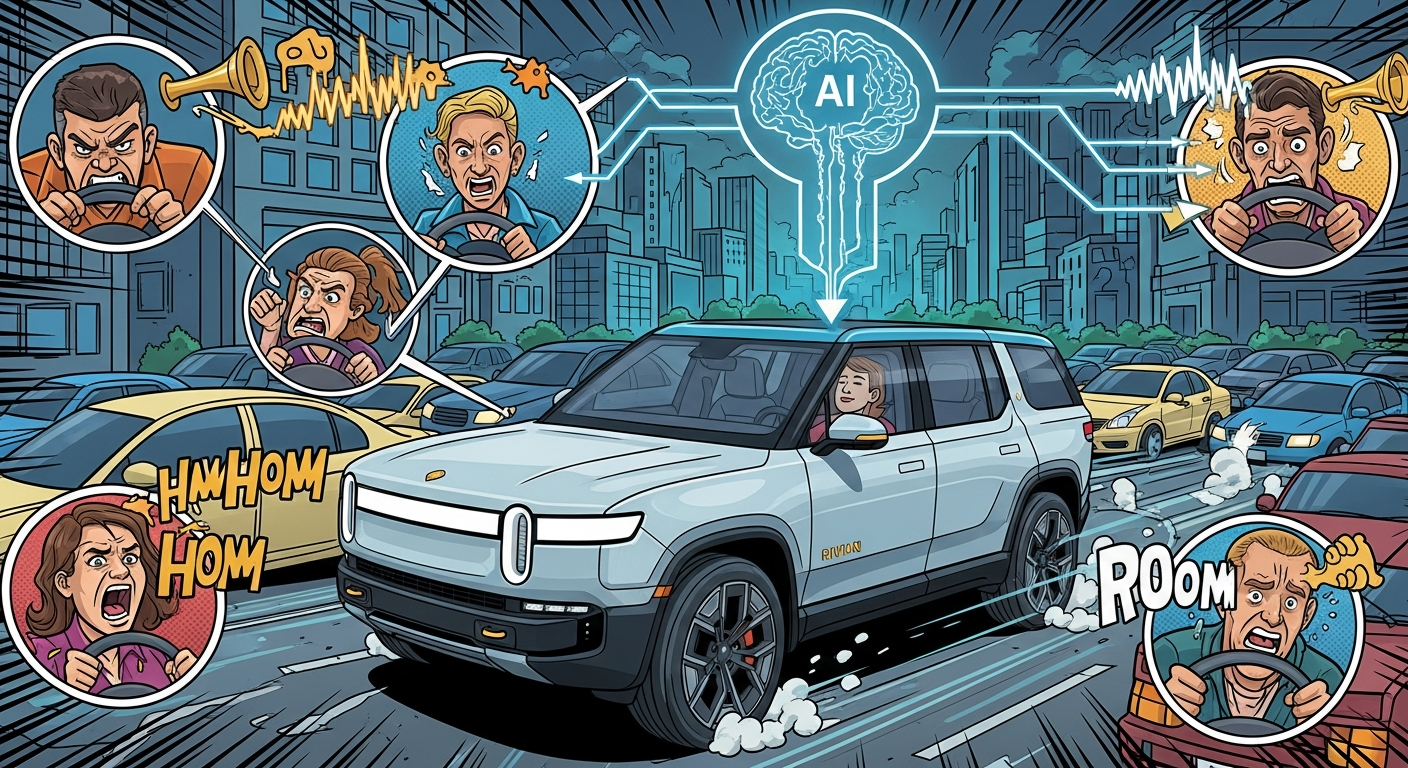
Rivian is set to introduce its proprietary AI assistant in early 2026 after a comprehensive two-year development process. Notably, this advanced technology won’t be limited to new vehicles—the company plans to deploy it across its entire existing electric vehicle fleet, including current R1T trucks and R1S SUVs already on the road.
The AI assistant represents a significant leap forward in vehicle interaction, enabling occupants to manage climate settings and navigate infotainment features through natural conversation. What sets Rivian’s approach apart is its innovative agentic framework that connects vehicle systems with external applications. Google Calendar integration will lead this third-party connectivity initiative.
The Technology Behind Rivian’s AI Assistant
At the core of this initiative is Rivian Unified Intelligence (RUI), a sophisticated architecture designed to be both model and platform agnostic. During the company’s AI & Autonomy event in Palo Alto, Software Development Chief Wassym Bensaid emphasized that this system will fundamentally transform how applications integrate with vehicles. “The beauty here is we can integrate third-party agents, and this is completely redefining how apps in the future will integrate in our cars,” Bensaid explained.
The assistant leverages Google Vertex AI and Gemini technologies to enhance its conversational capabilities, ensuring interactions remain natural while providing accurate, grounded information. Rivian has developed its own custom large language models alongside an orchestration layer that coordinates various AI functions seamlessly. This hybrid approach allows Rivian to maintain control over core functionality while partnering with specialized providers for specific capabilities.
Vertical Integration Strategy
The AI assistant program exemplifies CEO RJ Scaringe’s broader vision of vertical integration across Rivian’s operations. This philosophy extends beyond software to hardware development, including a custom 5nm processor created through collaborations with Arm and TSMC. These advancements will support expanded hands-free driving capabilities that may eventually allow drivers to divert their attention from the road.
Rivian’s commitment to building technology in-house became evident in 2024 when the company completely overhauled its flagship vehicles. The redesign touched virtually every aspect of the R1T and R1S models, from battery systems and suspension components to the electrical architecture, sensor arrays, and user interface.
Applications Beyond Vehicle Control
While the AI assistant’s primary function involves enhancing the driving experience, Rivian envisions broader applications for its RUI platform. Bensaid described it as “the connective tissue that runs through the very heart of Rivian’s digital ecosystem,” highlighting its role throughout the entire vehicle lifecycle.
One particularly promising application lies in vehicle diagnostics. The system will function as an expert assistant for service technicians, analyzing telemetry data and vehicle history to identify complex mechanical issues. This capability could significantly improve maintenance efficiency and reduce vehicle downtime for owners.
Development Team and Implementation Timeline
The development of Rivian’s AI assistant has been spearheaded by a specialized team within the company’s larger software division led by Bensaid. While Rivian has not disclosed the exact size of this team, they have confirmed that the assistant is designed with flexibility in mind, capable of adapting to various models and platforms within their ecosystem.
The early 2026 launch timeline suggests Rivian is taking a methodical approach to ensure the technology meets their quality standards before deployment. When released, the system will be made available to all existing Rivian owners, reinforcing the company’s commitment to supporting their current customer base rather than reserving advanced features exclusively for new purchasers.
Industry Context and Competitive Positioning
Rivian’s investment in proprietary AI technology positions the company distinctively in the increasingly competitive electric vehicle market. While many manufacturers rely heavily on partnerships with tech companies for advanced features, Rivian’s vertical integration approach gives them greater control over the user experience and technology roadmap.
This strategy mirrors efforts by other industry players like Tesla, which has long emphasized in-house software development. However, Rivian’s explicit focus on making new technologies backward compatible with existing vehicles represents a customer-centric approach that could strengthen brand loyalty in the evolving EV marketplace.