
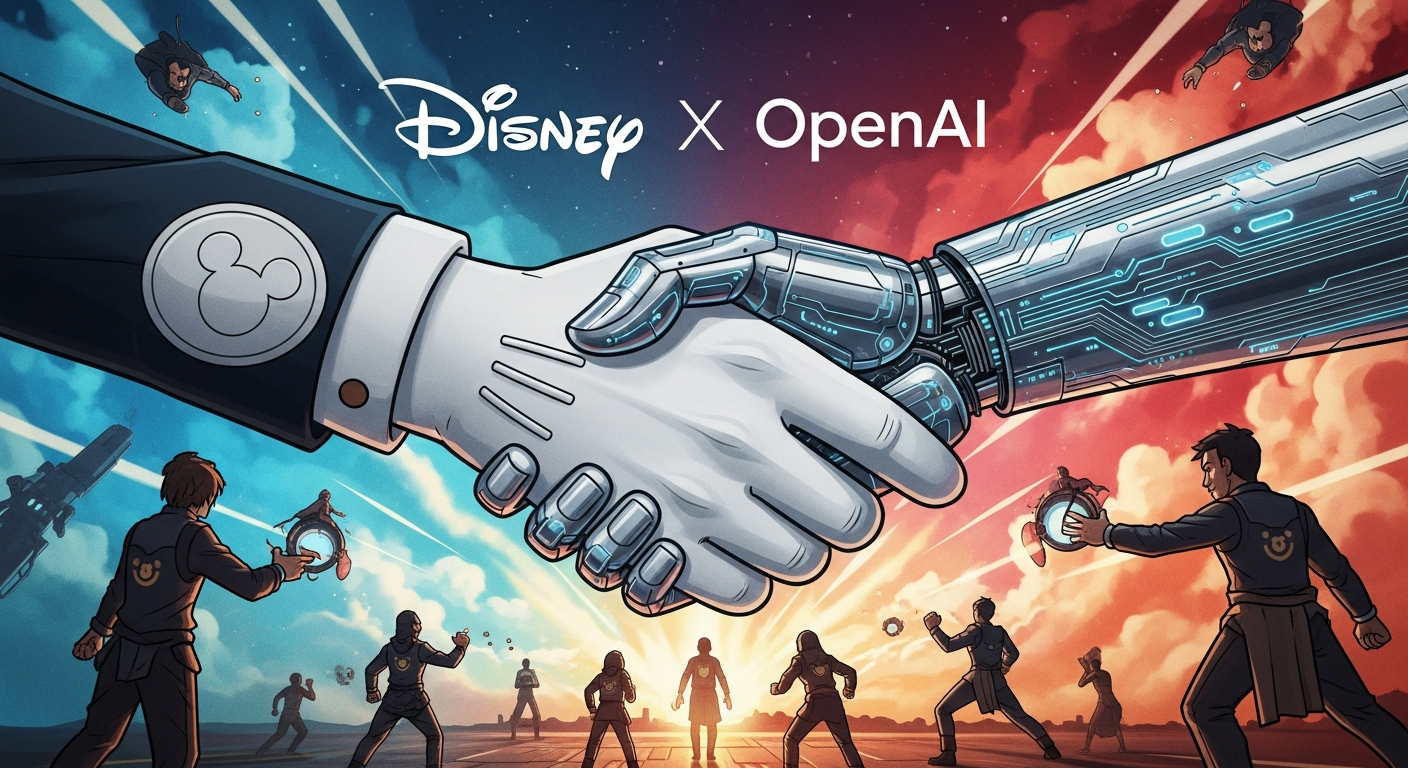
In a move that signals a fundamental shift in how entertainment giants approach artificial intelligence, Disney has announced a groundbreaking partnership with OpenAI valued at $1 billion. This collaboration, which would have seemed implausible just months ago given Disney’s historically aggressive intellectual property protection stance, represents a strategic pivot in how the entertainment industry is adapting to AI-generated content.
The partnership grants OpenAI permission to incorporate beloved Disney characters like Mickey Mouse, Ariel, and Yoda into its Sora video generation model beginning next year. Meanwhile, Disney secures both a significant equity position in OpenAI and provides its employees access to OpenAI’s APIs and ChatGPT tools. This arrangement reveals a sophisticated calculus about the future of entertainment in an AI-driven landscape.
Why Disney Changed Its Approach to AI
The timing of this deal is particularly noteworthy. Disney has been at the forefront of intellectual property litigation, joining Universal in legal action against Midjourney in June 2024 over alleged character infringement. Even more telling, Disney reportedly issued a cease-and-desist letter to Google regarding copyright violations just one day before announcing its OpenAI partnership.
This apparent contradiction actually reveals Disney’s nuanced strategy. The entertainment giant appears to be following the emerging playbook used by media publishers: forge licensing agreements where beneficial while pursuing litigation against unauthorized uses. Condé Nast, WIRED’s parent company, made a similar move by partnering with OpenAI in August 2024.
Professor Matthew Sag, an expert in law and artificial intelligence at Emory University, explains the underlying reality: “AI companies and copyright holders are beginning to understand and become reconciled to the fact that neither side is going to score an absolute victory.” The legal landscape currently suggests that while AI training data (inputs) may be protected under fair use, the content AI produces (outputs) gives IP owners like Disney much stronger legal standing.
The Technical Challenge of Character Control
A key factor driving this partnership is what legal scholars call the “Snoopy problem” – or in this context, the “Disney problem.” Even if an AI company explicitly programs its models not to generate Disney characters, the models may have learned enough about these characters to create them anyway. Users can also potentially engineer prompts that produce Disney-like characters without directly naming them.
This technical reality creates an enforcement nightmare. Rather than fighting an unwinnable battle, Disney has opted for collaboration. The partnership gives Disney influence over how its characters appear in Sora-generated videos while establishing guardrails against harmful or illegal content.
Strategic Benefits for Both Companies
For Disney, this partnership delivers multiple advantages. First, it gains a measure of control over how its intellectual property appears in AI-generated content. Second, Disney+ will feature curated “fan-inspired Sora short form videos,” opening new storytelling avenues for the century-old studio. Third, Disney’s employees gain access to cutting-edge AI tools, potentially accelerating innovation across its businesses.
The $1 billion investment also represents a strategic hedge similar to Disney’s $1.5 billion stake in Fortnite developer Epic Games last year. As entertainment consumption shifts toward interactive and personalized experiences, these investments position Disney to meet audiences on emerging platforms.
OpenAI secures not just substantial capital for its scaling ambitions but also access to Disney’s treasure trove of over 200 internationally recognized characters. This enriches Sora’s creative capabilities while establishing a template for future entertainment industry partnerships.
The New Reality of AI and IP
Disney CEO Robert Iger framed the partnership as putting “imagination and creativity directly into the hands of Disney fans in ways we’ve never seen before.” This statement acknowledges a fundamental shift – rather than merely protecting its characters from AI, Disney is now strategically deploying them through AI.
The deal effectively signals that the AI copyright war has entered a new phase. The question is no longer whether iconic characters will appear in AI models, but rather what price and terms will govern their inclusion. Other entertainment companies will likely follow suit, recognizing that collaboration may be more effective than litigation in the rapidly evolving AI landscape.
A real-world example of this shift can be seen in how Disney is planning to incorporate AI into its creative processes. Rather than viewing AI as merely a threat to traditional animation and storytelling, Disney appears to be exploring how these tools can enhance its creative capabilities while maintaining the company’s signature quality and emotional resonance.
Implications for the Entertainment Industry
This partnership establishes a potential template for how entertainment companies might approach AI going forward. Instead of an all-or-nothing legal battle, we’re likely to see more nuanced arrangements that balance protection with innovation.
For creators and fans, this means AI-generated content featuring beloved characters may soon become officially sanctioned rather than existing in a legal gray area. It also suggests that entertainment companies are preparing for a future where AI-assisted creation becomes a standard part of the production process.
The most forward-thinking entertainment executives recognize that fighting AI entirely may be futile. By establishing partnerships now, companies like Disney can help shape how these technologies develop rather than merely reacting to them after the fact.
As AI-generated entertainment continues to evolve, these early partnerships will likely prove decisive in determining which companies successfully navigate the transition and which ones struggle to adapt to new creative paradigms.