
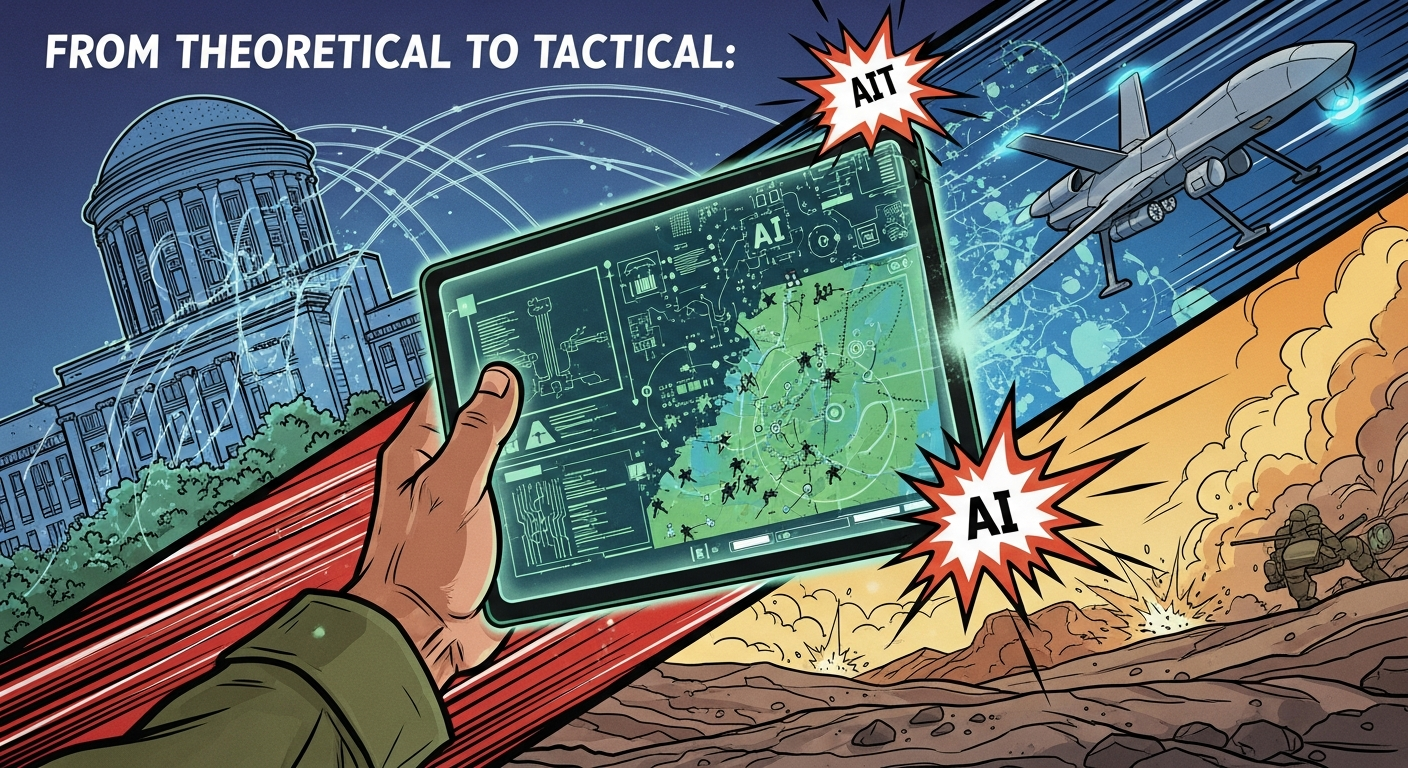
The Massachusetts Institute of Technology (MIT) is set to revolutionize naval officer education with a groundbreaking program that merges artificial intelligence expertise with naval engineering. The newly established “2N6: Applied Artificial Intelligence Program for Naval Officers” represents a significant advancement in military technical education, combining MIT’s 125-year legacy in naval construction with cutting-edge AI applications specifically designed for national security challenges.
Developed through collaboration between MIT’s Department of Mechanical Engineering (MechE) and Department of Electrical Engineering and Computer Science (EECS), this two-year master’s program will equip officers with specialized AI knowledge applicable to critical naval operations. The program addresses the growing recognition that AI serves as a powerful force multiplier in military contexts, enhancing decision-making capabilities while reducing operational risks.
Program Structure and Curriculum Focus
The 2N6 program offers a comprehensive Master of Science degree in Mechanical Engineering complemented by an AI certificate awarded through the MIT Schwarzman College of Computing. This structure provides naval officers with both theoretical foundations and practical applications of artificial intelligence in military contexts.
Commander Christopher MacLean, MIT associate professor of practice in mechanical engineering, emphasizes that “AI is a force multiplier” with applications spanning “data processing, decision support, unmanned systems, cyber defense, logistics, energy management” and numerous other military domains. The curriculum specifically satisfies the U.S. Navy’s sub-specialty code requirements for Applied Artificial Intelligence.
Core coursework includes specialized topics such as AI-enhanced decision-making for computational exercises, AI applications in naval manufacturing and design, and artificial intelligence for marine autonomy of both surface and underwater vehicles. This practical focus ensures graduates can immediately apply their knowledge to real-world naval challenges.
Origins and Strategic Importance
The program’s creation followed a pivotal campus visit by Admiral Samuel Paparo, commander of the U.S. Indo-Pacific Command. During discussions with MIT leadership, Admiral Paparo recognized the potential for an applied AI program that would build upon MIT’s established naval engineering excellence while addressing emerging technological needs.
Dan Huttenlocher, dean of the MIT Schwarzman College of Computing, highlights the program’s significance: “I’m honored that the college can contribute to and support such a vital program that will equip our nation’s naval officers with the technical expertise they need for mission-relevant challenges.”
The strategic timing of this program coincides with rapidly evolving global security challenges and technological capabilities. By focusing specifically on naval applications of AI, MIT positions itself at the intersection of two critical domains: maritime operations and artificial intelligence advancement.
Building on a Century of Naval Engineering Excellence
MIT’s involvement with naval engineering dates back over a century, with the Institute’s 2N program approaching its 125th anniversary in 2026. This historical foundation provides a robust platform for integrating cutting-edge AI applications with deep maritime engineering expertise.
The Institute’s current naval research encompasses advanced work in fluid mechanics, hydrodynamics, acoustics, offshore mechanics, marine robotics, and ocean sensing technologies. The 2N6 program leverages this established knowledge base while pushing into new frontiers of AI application.
John Hart, head of MechE at MIT, emphasizes this connection: “In MechE, we are embracing the use of AI to explore new frontiers in research and education, with deep grounding in the fundamentals, design, and scaling of physical systems. With the 2N6 program, we’re proud to be at the helm of such an important charge in training the next generation of leaders for the Navy.”
Future Expansion and National Security Impact
While initially operating as a two-year pilot program exclusively for U.S. Navy officers, 2N6 has been designed with expansion in mind. Future cohorts may include officers from other military branches and potentially civilian students pursuing careers in defense technology.
Themis Sapsis, director of MIT’s Center for Ocean Engineering, envisions broader implications: “We believe that 2N6 can model a new paradigm for advanced AI education focused more broadly on supporting national security.” This perspective suggests the program could become a template for similar specialized AI education initiatives across the defense sector.
The program’s emphasis on application-focused learning addresses a critical gap in military technical education. Rather than teaching AI concepts in isolation, 2N6 continuously connects artificial intelligence capabilities to specific naval and military use cases, ensuring graduates can translate theoretical knowledge into operational advantages.
Interdisciplinary Collaboration for Complex Challenges
The joint development of 2N6 between mechanical engineering and computer science departments reflects MIT’s commitment to interdisciplinary solutions for complex problems. Asu Ozdaglar, deputy dean of the MIT Schwarzman College of Computing and head of EECS, notes that “breakthroughs in artificial intelligence are reshaping society and advancing human decision-making and creativity,” making this collaboration particularly timely.
By combining expertise from these two domains, the program creates a unique educational environment where naval engineering challenges meet state-of-the-art AI solutions. This approach mirrors the increasingly interdisciplinary nature of modern military operations, where technological capabilities must be seamlessly integrated with traditional maritime strategies.
The 2N6 program represents a significant evolution in specialized military education, positioning MIT at the forefront of preparing naval officers for a future where artificial intelligence will increasingly determine operational effectiveness and national security outcomes.