In 2016, a young father in Minneapolis received a startling package from Target: coupons for baby clothes and cribs. The retailer had analyzed his teenage daughter’s purchasing patterns and correctly deduced her pregnancy before he knew. This wasn’t clairvoyance—it was an algorithm at work, silently processing fragments of data to construct a portrait of human behavior. The incident provoked outrage, but it also revealed a fundamental truth about our digital age: algorithms aren’t just watching us; they’re learning from us in ways most of us barely comprehend.
When we speak of artificial intelligence today, we often anthropomorphize the process, imagining machines that think like humans. The reality is both more mundane and more fascinating. Algorithms don’t learn the way humans do—they don’t have moments of inspiration or emotional breakthroughs. Instead, they perform a mathematical dance with our data, finding patterns and correlations that would be invisible to the human eye.
The Anatomy of Machine Learning
At its core, an algorithm is simply a set of instructions—a recipe for solving a particular problem. But machine learning algorithms have a distinctive quality: they modify themselves based on experience. This self-modification is what we colloquially call “learning,” though the process bears little resemblance to human education.
“The basics everyone should know about AI learning begin with understanding that algorithms don’t truly ‘understand’ anything,” explains Dr. Melanie Mitchell, computer scientist and author of “Artificial Intelligence: A Guide for Thinking Humans.” “They’re pattern-matching systems operating on mathematical principles, not conscious entities developing insight.”
Consider how a recommendation algorithm works on a streaming service. It doesn’t watch movies and develop taste. Instead, it tracks correlations: if you watched these five films, and other users who watched those same films also enjoyed this sixth one, the algorithm recommends it to you. The system builds a mathematical model of your preferences by analyzing your behavior in relation to others’.
This process typically involves three stages: training, validation, and deployment. During training, algorithms ingest vast quantities of data—your clicks, purchases, and viewing habits—and adjust their internal parameters to minimize prediction errors. In validation, they test these parameters against new data. Finally, in deployment, they apply their learning to make predictions or classifications about fresh information—including your future behavior.
The Data Diet: What Algorithms Consume
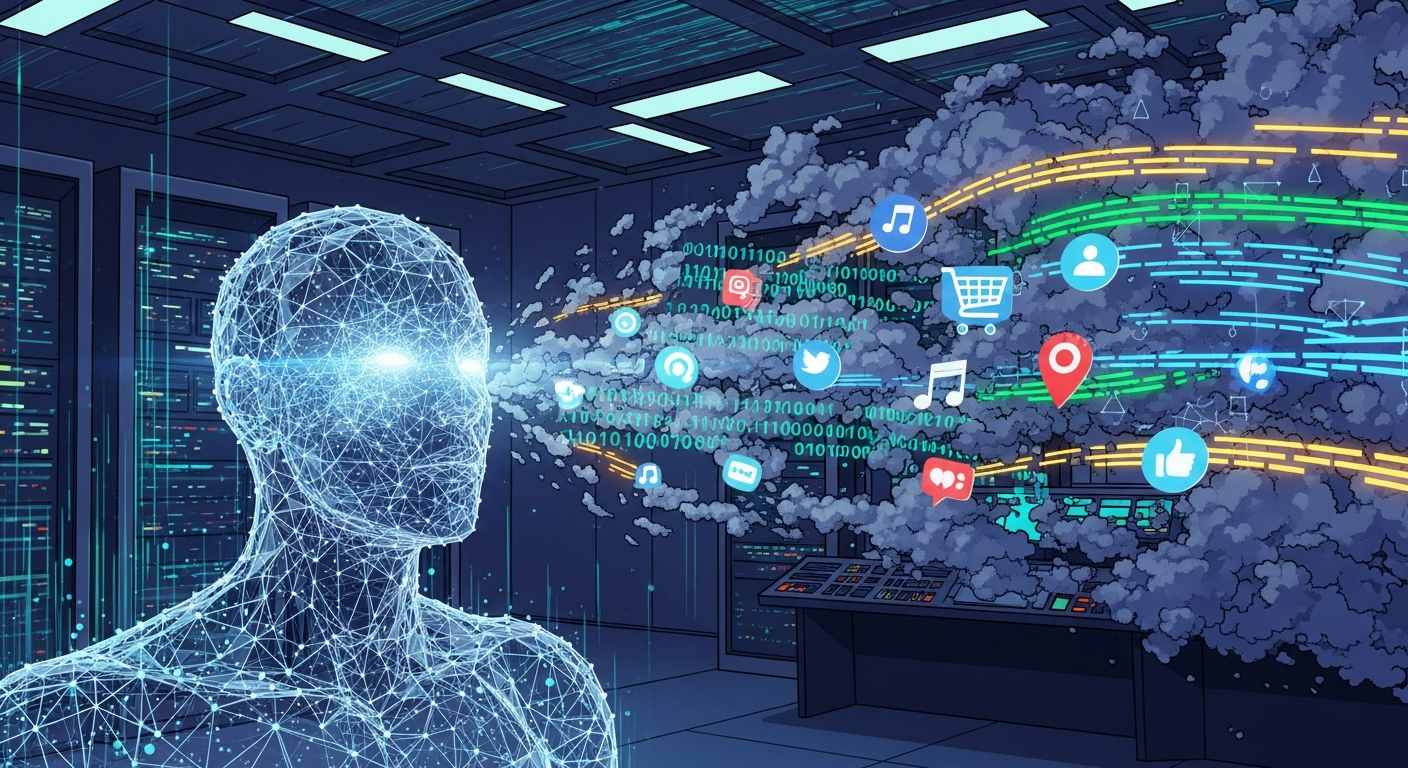
Algorithms are voracious, indiscriminate consumers of data. Every digital action—from mundane Google searches to heart rate readings on your fitness tracker—potentially feeds into various learning systems. But not all data is equally nutritious for algorithms.
“What many people don’t realize is that the quality of machine learning outputs depends entirely on the inputs,” says Dr. Timnit Gebru, computer scientist and advocate for ethical AI. “When we say ‘garbage in, garbage out,’ we’re describing a fundamental limitation of these systems.”
Your explicit actions—likes, shares, purchases—provide the most straightforward data. But algorithms also consume implicit signals: how long you hover over an item before clicking, the time of day you’re most active, even the speed at which you scroll through content. These behavioral breadcrumbs often reveal more about your preferences than your conscious choices.
Moreover, algorithms don’t just learn from your individual data—they learn from collective patterns. Your information gains significance when analyzed alongside millions of other users’ behaviors. This aggregation allows systems to identify subtle correlations: that people who purchase flashlights often buy batteries within three days, or that users who read articles about gardening in winter are likely to book tropical vacations in January.
The Hidden Mechanics of Personalization
The term “personalization” suggests a bespoke service, carefully crafted for your unique needs. The reality is more industrial. Algorithms typically sort users into thousands of micro-segments based on behavioral similarities, then serve content optimized for each segment. You’re not receiving truly personalized recommendations—you’re being assigned to increasingly specific categories.
“Personalization algorithms don’t know you as a person,” notes Dr. Cathy O’Neil, mathematician and author of “Weapons of Math Destruction.” “They know you as a collection of data points that resemble patterns they’ve seen before. It’s pattern recognition, not personal understanding.”
This pattern recognition operates through various technical approaches. Supervised learning algorithms require labeled data—examples of correct answers—to learn from. Unsupervised learning finds patterns without predefined categories. Reinforcement learning improves through trial and error, optimizing for specific rewards like user engagement or purchasing behavior.
Deep learning, a subset of machine learning that’s powered recent AI advances, uses artificial neural networks inspired by the human brain’s structure. These systems excel at identifying complex patterns in unstructured data like images, text, and natural language—enabling applications from facial recognition to language translation.
The Paradox of Algorithmic Learning
Perhaps the most profound aspect of algorithmic learning is its paradoxical nature: these systems simultaneously know too much and too little about us. They can predict with unsettling accuracy which advertisement might prompt a purchase, yet fundamentally misunderstand the context of human behavior.
Algorithms excel at correlation but struggle with causation. They can detect that you frequently order takeout on rainy Tuesdays but can’t comprehend that you do so because your children have soccer practice those evenings. This limitation creates a curious dynamic where AI systems can seem both eerily prescient and comically obtuse.
“The gap between algorithmic prediction and genuine understanding represents one of the most important distinctions everyone should grasp about modern AI,” argues Dr. Kate Crawford, researcher and author of “Atlas of AI.” “These systems can model human behavior without modeling human meaning.”
This distinction matters profoundly as algorithms increasingly mediate our access to information, opportunities, and each other. A recommendation algorithm that optimizes for engagement might lead us down increasingly extreme content paths. A hiring algorithm trained on historical data might perpetuate existing biases. A content moderation system might fail to distinguish between harmful speech and discussions about harm.
Understanding how algorithms learn from our information isn’t merely technical curiosity—it’s becoming a form of civic literacy. As these systems increasingly shape our digital and physical environments, our ability to navigate them consciously depends on recognizing both their capabilities and their fundamental limitations. They may be learning from us constantly, but perhaps it’s time we learned more about them.