
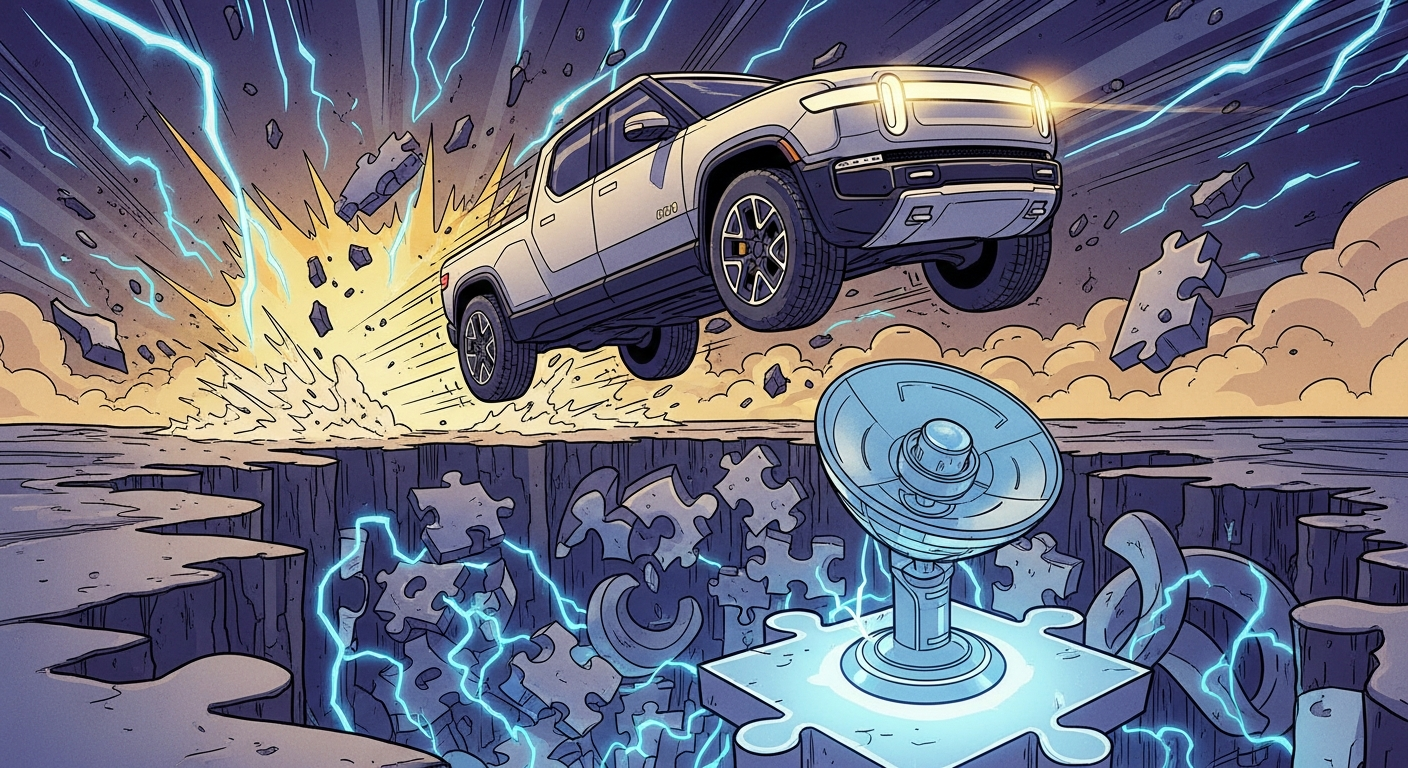
Rivian has unveiled sweeping plans to advance its autonomous driving capabilities, showcasing new technology and strategic initiatives during its inaugural ‘Autonomy & AI Day’ event in Palo Alto. CEO RJ Scaringe detailed how the electric vehicle manufacturer intends to compete aggressively in the self-driving space, potentially challenging established players like Tesla, Ford, GM, and Waymo.
The company’s announcements come at a critical juncture as Rivian prepares for the production of its more affordable R2 SUV, scheduled to launch in the first half of 2026. These revelations serve not only as technological milestones but also as reassurance to investors that Rivian remains at the cutting edge of autonomous driving innovation.
Expanded Hands-Free Driving Capabilities
Rivian announced significant expansion of its hands-free driving assistance software, which will cover more than 3.5 million miles of roads throughout the United States and Canada. Initially available on highways, the technology will eventually extend to surface streets as well. This enhanced functionality, branded as ‘Universal Hands-Free,’ will debut on Rivian’s second-generation R1 trucks and SUVs in early 2026.
Customers can access this feature through either a one-time payment of $2,500 or a monthly subscription of $49.99. The system will enable point-to-point navigation, allowing drivers to input a destination and let the vehicle handle the entire journey autonomously.
Progressive Autonomy Roadmap
Rivian outlined a multi-stage approach to autonomous driving development. Following the initial hands-free capabilities, the company plans to introduce technology that allows drivers to divert their attention from the road entirely – enabling activities like phone use or reading while the vehicle operates independently.
The most ambitious phase of Rivian’s roadmap involves what the company terms ‘personal L4′ autonomy – referencing Level 4 in the Society of Automotive Engineers’ classification system. At this level, vehicles can operate without human intervention within specific operational domains.
Scaringe hinted at Rivian’s potential entry into the ride-hailing market once these technologies mature. ‘While our initial focus will be on personally owned vehicles, which today represent a vast majority of the miles driven in the United States, this also enables us to pursue opportunities in the rideshare space,’ he stated during the presentation.
Proprietary Technology Development
To achieve these ambitious goals, Rivian is developing a ‘large driving model’ – conceptually similar to large language models but specifically designed for real-world driving scenarios. This represents a departure from the rules-based frameworks traditionally used in autonomous vehicle development.
The company also revealed its custom-designed 5nm processor, developed in partnership with Arm and TSMC. This chip will power Rivian’s third-generation ‘autonomy computer’ (ACM3), capable of processing 5 billion pixels per second. The ACM3 will be integrated into the R2 SUV starting in late 2026, several months after the vehicle’s initial launch.
Complementing this computing power, Rivian will incorporate lidar sensors at the windshield to provide three-dimensional spatial data and redundant sensing capabilities. The company emphasizes that this additional sensor will enhance real-time detection for challenging driving scenarios.
Implementation Timeline and Hardware Strategy
Rivian’s technology rollout follows a staggered approach. The initial R2 SUVs, scheduled for delivery in the first half of 2026, will not include the ACM3 processor or lidar sensors. However, the company has committed to continuously improving autonomy capabilities across both its second-generation R1 vehicles and future R2 models.
An interesting aspect of Rivian’s strategy is its belief that significant autonomous functionality can be achieved in current vehicles without the new hardware suite. Nevertheless, Scaringe emphasized that the advanced hardware will ‘enable a much higher ceiling than we have in our vehicles today,’ suggesting that the most sophisticated self-driving features will require the updated technology.
Market Positioning and Competitive Landscape
Rivian’s autonomous driving push positions the company as a serious contender in a field dominated by Tesla’s Full Self-Driving technology and traditional automakers’ advanced driver assistance systems. By developing proprietary hardware and software solutions, Rivian aims to differentiate itself in the increasingly competitive electric vehicle market.
The company’s approach of combining lidar with advanced computing represents a contrast to Tesla, which has famously rejected lidar in favor of camera-based systems. This technical divergence highlights the ongoing debate within the industry about the optimal sensor suite for achieving reliable autonomous driving.
Rivian’s timeline for implementing these technologies aligns with industry expectations for when more advanced autonomous features might become widely available. The 2026 target for eyes-off driving capabilities suggests the company believes significant regulatory and technical hurdles can be overcome within that timeframe.