
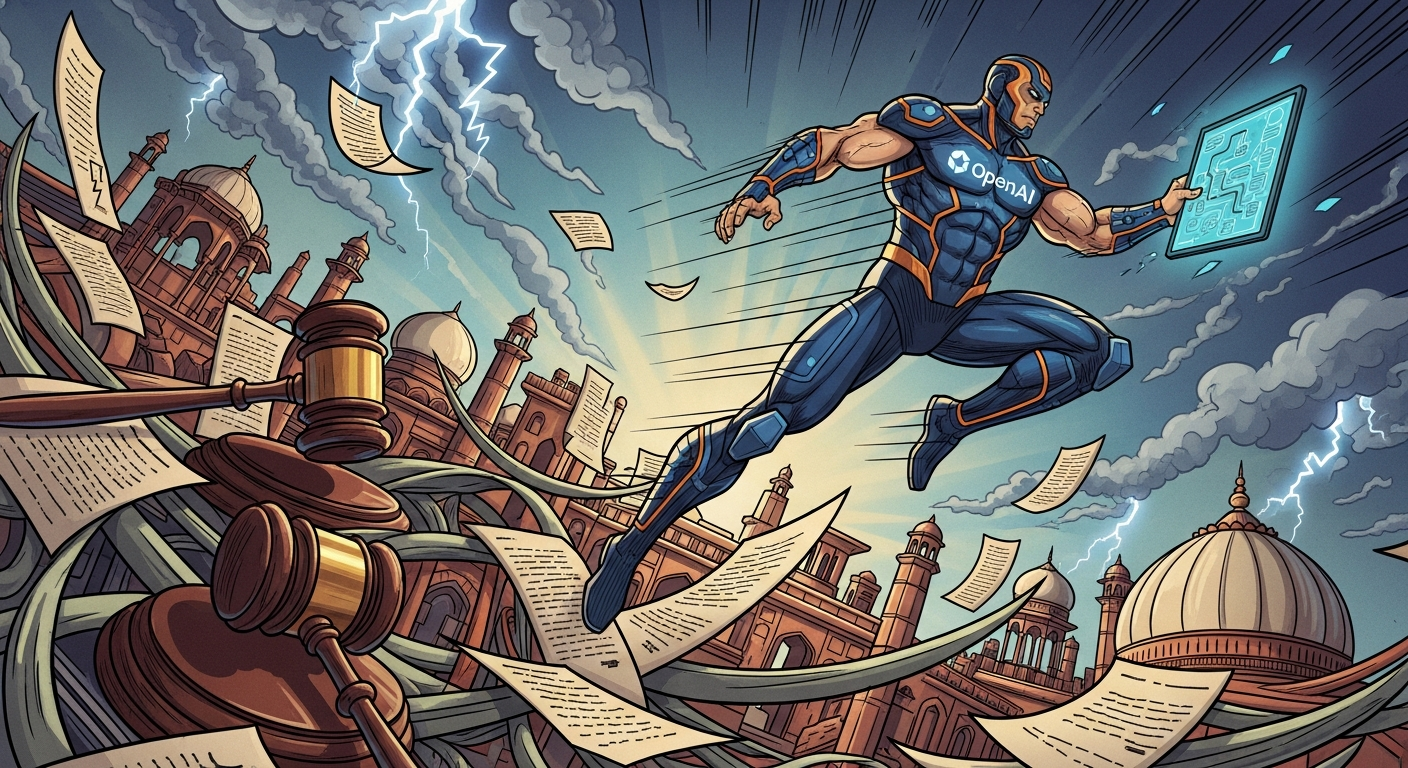
India has unveiled a groundbreaking proposal that could fundamentally alter how artificial intelligence companies operate within its borders. The Department for Promotion of Industry and Internal Trade recently introduced a framework requiring AI developers to pay royalties when using copyrighted material to train their models—potentially establishing one of the world’s most proactive approaches to balancing AI innovation with creator rights.
This initiative comes at a critical moment as India emerges as a pivotal market for AI giants. OpenAI’s CEO Sam Altman has noted that India already represents their second-largest user base globally, with potential to become their primary market. The timing is particularly significant as legal battles over AI training data intensify worldwide, with no clear international consensus on how copyright laws apply to machine learning.
The Mandatory Blanket License: A New Approach to AI Regulation
At the core of India’s proposal is a mandatory blanket license system that would create a streamlined pathway for AI companies to access copyrighted content. Unlike the uncertain legal landscapes in the United States and European Union, where fair use boundaries remain contested, India’s approach would establish clear rules from the outset.
The framework would establish a central collecting body comprised of rights-holding organizations. AI developers would pay royalties to this entity, which would then distribute compensation to creators whose works were used for training purposes. This approach aims to eliminate the need for thousands of individual negotiations while ensuring creators receive fair compensation.
The eight-member government committee that developed the proposal argues this system offers multiple advantages: it provides AI companies with legal certainty, reduces transaction costs across the ecosystem, and establishes immediate compensation mechanisms for creators whose works contribute to AI development.
Global Context: A Different Path Than Western Markets
India’s proposal stands in stark contrast to approaches being debated in other major markets. In the United States, courts are still determining whether AI training on copyrighted materials qualifies as fair use, with multiple high-profile lawsuits pending from news organizations, authors, and visual artists against companies like OpenAI and Google.
The European Union has focused primarily on transparency requirements and establishing clearer boundaries around data usage, but has not proposed a comprehensive royalty system. India’s approach represents one of the most interventionist frameworks globally, essentially creating a compulsory licensing regime specifically for AI.
This regulatory divergence creates interesting dynamics for multinational AI companies. If implemented, they would face different compliance requirements across markets—potentially leading to region-specific AI development practices or even different versions of AI models depending on training data access.
Industry Pushback: Not Everyone Supports the Framework
The proposal has already generated significant opposition from technology industry representatives. Nasscom, which represents major tech companies including Google and Microsoft in India, filed a formal dissent against the framework. The organization argued that India should instead adopt a broad text-and-data-mining exception that would permit AI training on lawfully accessed content without mandatory payments.
Similarly, the Business Software Alliance—representing global tech firms like Adobe, Amazon Web Services, and Microsoft—has urged the Indian government to reconsider its approach. The BSA warned that limiting AI models to smaller sets of licensed or public-domain material could reduce model quality and potentially increase biases in AI outputs.
These industry groups advocate for an opt-out model rather than mandatory licensing, arguing that creators who object to their work being used should have the ability to exclude it, rather than forcing companies to pay for all training data regardless of creator preference.
Case Study: The ANI Lawsuit
The regulatory proposal comes amid concrete legal challenges already unfolding in India. News agency ANI has sued OpenAI in the Delhi High Court, claiming its articles were used without permission to train ChatGPT. This case has prompted judicial examination of whether AI training itself constitutes an act of reproduction or might be protected under India’s