
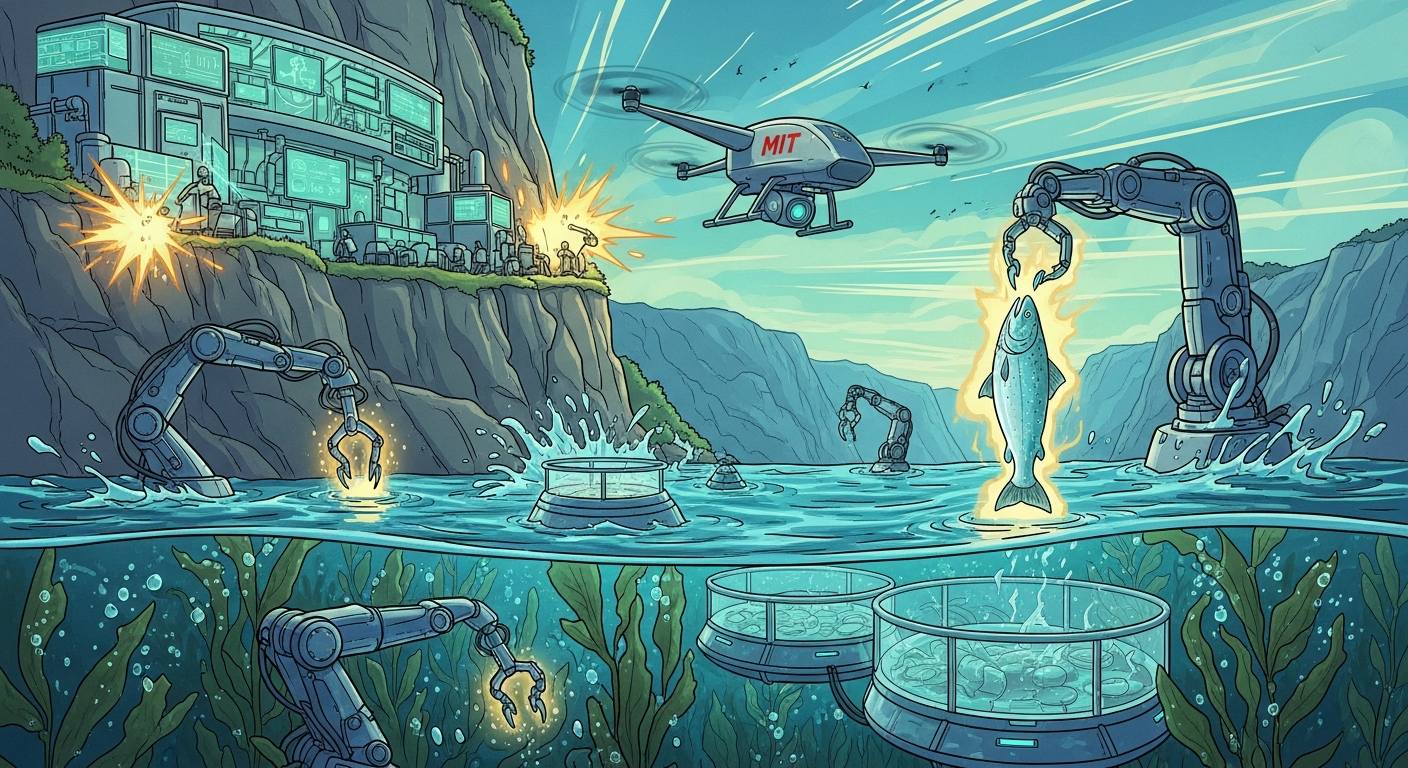
Norway leads the world in Atlantic salmon farming while the United States remains the largest importer of seafood products. This growing industry intersection has prompted MIT to launch an innovative international exchange program that’s preparing students to tackle complex challenges in offshore aquaculture through cutting-edge technology.
The AquaCulture Shock initiative, developed by MIT Sea Grant in partnership with MIT-Scandinavia MISTI (MIT International Science and Technology Initiatives), recently sent two talented MIT undergraduates to Trondheim, Norway to work at SINTEF Ocean, one of Europe’s premier research institutions. This collaboration represents a strategic investment in an emerging field where technological innovation meets sustainable food production.
Bridging Education Gaps in Aquaculture Technology
While coastal aquaculture has established roots across Massachusetts and the United States, open-ocean farming presents unique challenges that require specialized expertise. The AquaCulture Shock program specifically addresses this knowledge gap by immersing students in environments where offshore aquaculture technology is most advanced.
Madeline Smith, managing director for MIT-Scandinavia, emphasized the program’s value: “The opportunity to work on this hands-on aquaculture project, under a world-renowned research institution, in an area of the world known for its innovation in marine technology — this is what MISTI is all about. Students gain valuable experience while developing cultural understanding and skills that prepare them as future global leaders.”
The program builds on a foundation established in 2023 when MIT Sea Grant hosted Eleni Kelasidi, a visiting research scientist from SINTEF Ocean’s ACE-Robotic Lab. This initial collaboration between MIT and Norwegian institutions focused on controllers, models, and underwater vehicles for aquaculture applications.
Students Tackling Real-World Aquaculture Challenges
Beckett Devoe, a senior studying artificial intelligence and decision-making, and Tony Tang, a junior in mechanical engineering, were selected for the inaugural internships. Both previously worked with MIT Sea Grant through the Undergraduate Research Opportunities Program (UROP), contributing to projects on wave generator design and machine learning applications for analyzing oyster larvae health.
At SINTEF Ocean’s Aquaculture Robotics and Autonomous Systems Laboratory, each student tackled distinct challenges facing the industry. Devoe focused on AI applications for optimizing fish feeding—the largest expense in aquaculture operations. His project analyzed various farm parameters including fish size and water temperature to recommend optimal feeding amounts that balance fish health with cost efficiency.
Tang worked on simulating underwater vehicle-manipulator systems designed to navigate farms and repair damaged cage nets with robotic arms. This work addresses a critical maintenance challenge in offshore environments where human divers face significant limitations and risks.
Norway’s Technological Leadership in Aquaculture
Norway’s geography of sheltered fjords creates ideal conditions for sea-based aquaculture, with approximately 1,000 fish farms operating along its coastline. Sveinung Ohrem, research manager for SINTEF Ocean’s Aquaculture Robotics and Automation Group, explained that the scale of operations has driven significant technological innovation.
The country currently deploys thousands of aquaculture robots, creating both opportunities and challenges. “You can’t have 8,000 people controlling 8,000 robots—that’s not economically or practically feasible. So the level of autonomy in all of these robots needs to be increased,” Ohrem noted.
Technologies currently employed include sophisticated decision-making systems that gather and visualize data, inspection and cleaning robots, environmental sensors measuring oxygen and temperature, echosounders tracking fish location, and cameras estimating biomass to optimize feeding.
Field Experience at Industrial-Scale Farms
A highlight of the internship program was the students’ visit to Singsholmen, an industrial-scale salmon farm on the island of Hitra. Operated through a collaboration between SINTEF Ocean and SalMar (the world’s second-largest salmon producer), the facility features ten massive net pens approximately 50 meters across, each holding up to 200,000 salmon.
This field experience provided crucial context that couldn’t be gained in a laboratory setting. As Tang described, “I got to physically touch the nets and see how the [robotic] arm might be able to fix the net.” Kelasidi emphasized that such experiences help students understand “the scale of the challenges, or the scale of the facilities.”
The Interdisciplinary Nature of Aquaculture Innovation
Both SINTEF researchers highlighted the deeply interdisciplinary nature of aquaculture technology development. Kelasidi, who now leads the Field Robotics Lab at the Norwegian University of Science and Technology (NTNU), described aquaculture as “one of the most challenging field domains we can demonstrate any autonomous solutions, because everything is moving.”
This dynamic environment requires students with backgrounds in both biology and technology. “We cannot develop technologies that are applied for industries where we don’t have biological components,” Kelasidi explained, “and then apply them somewhere where we have a live fish or other live organisms.”
Fish welfare remains the primary consideration for researchers and companies in this growing industry. The complex interplay between biological systems and engineering solutions demands collaborative approaches across institutions and national boundaries.
Future Opportunities and Expansion
Building on the success of the initial program, MIT Sea Grant and the MIT-Scandinavia MISTI program are recruiting four additional MIT students for internships in Norway this summer. These positions will focus on autonomy, deep learning, simulation modeling, underwater robotic systems, and other aquaculture-related technologies at institutions including NTNU’s Field Robotics Lab in Trondheim.
This expanding initiative represents an important investment in preparing the next generation of engineers and scientists to develop sustainable solutions for global food production challenges. As MIT Sea Grant director Michael Triantafyllou noted, “Norway is at the forefront of offshore aquaculture and MIT Sea Grant is investing in this field, so we anticipate great results from the collaboration.”