
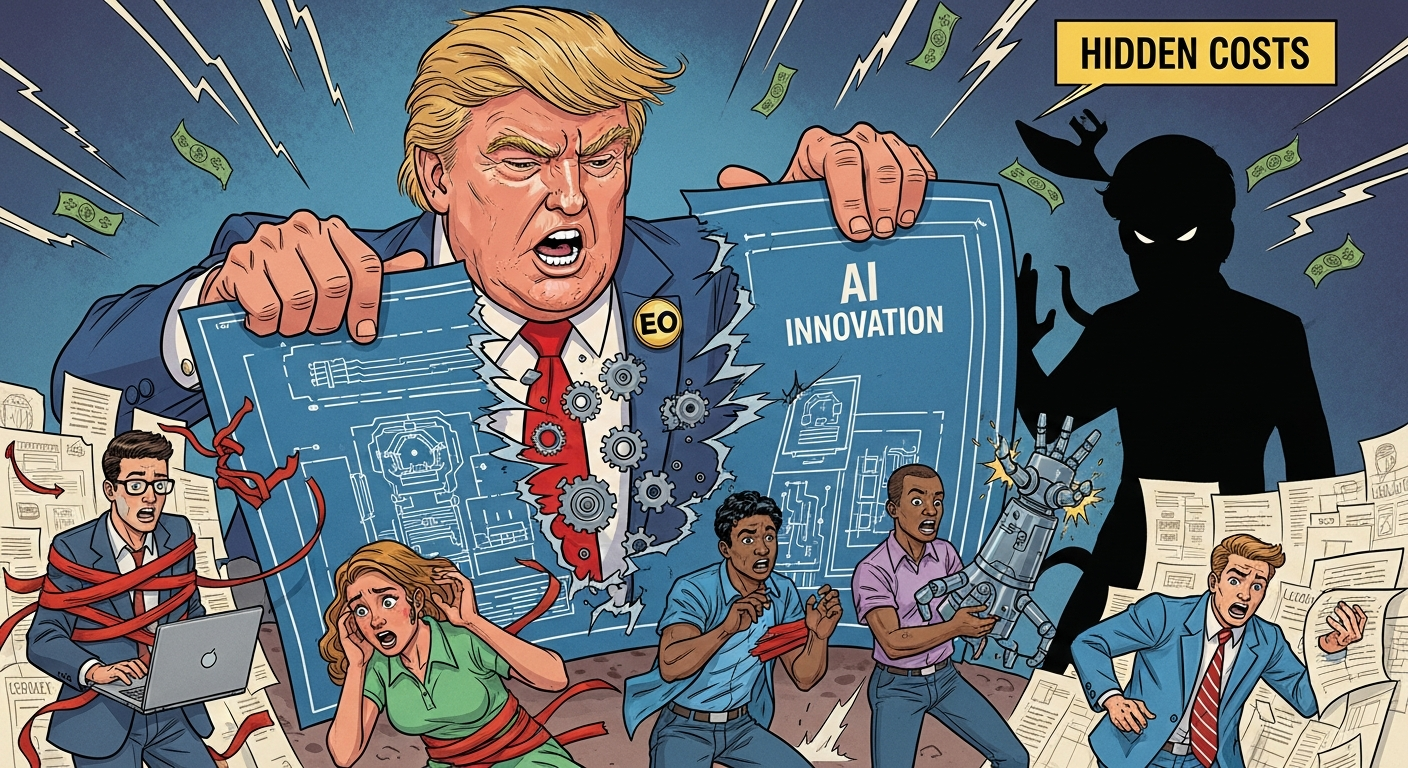
President Trump’s latest executive order targeting state-level artificial intelligence regulations has ignited fierce debate across the tech industry and legal communities. Signed Thursday evening, the directive aims to dismantle what the administration calls a ‘burdensome patchwork’ of state AI laws, but experts warn it may create more problems than it solves for the very startups it claims to protect.
The executive order, formally titled ‘Ensuring a National Policy Framework for Artificial Intelligence,’ establishes an aggressive timeline for federal intervention in state AI governance. Within just 30 days, the Justice Department must create a dedicated task force to challenge state AI laws, arguing that artificial intelligence constitutes interstate commerce that falls under federal jurisdiction. The Commerce Department faces a 90-day deadline to compile what the order describes as ‘onerous’ state regulations—a designation that could impact states’ eligibility for federal funding, including critical broadband grants.
The Strategy Behind Trump’s AI Regulatory Push
This executive action emerges amid stalled congressional efforts to temporarily pause state-level AI regulations. The initiative, spearheaded by David Sacks, Trump’s appointed AI and cryptocurrency policy czar, has drawn criticism from advocacy groups concerned about accountability.
Michael Kleinman, who leads U.S. Policy at the Future of Life Institute, characterized the order as ‘a gift for Silicon Valley oligarchs who are using their influence in Washington to shield themselves and their companies from accountability.’ The institute, which focuses on mitigating extreme risks from transformative technologies, represents one voice in a growing chorus of concern about the order’s implications.
Even those who support the concept of a unified national framework acknowledge the executive order falls short of actually creating one. Instead, it initiates what legal experts predict will be protracted court battles, leaving startups navigating an increasingly complex regulatory landscape during the transition period.
Legal Experts Predict Constitutional Showdown
Sean Fitzpatrick, CEO of LexisNexis North America, U.K., and Ireland, anticipates states will vigorously defend their consumer protection authority, potentially taking these challenges all the way to the Supreme Court. This creates a paradoxical situation where an order intended to provide regulatory clarity may instead generate years of legal uncertainty.
Gary Kibel, partner at Davis + Gilbert, questioned whether an executive order represents the appropriate vehicle for overriding democratically enacted state laws. He warned that the current regulatory vacuum could lead to two problematic extremes: either overly restrictive rules or a complete absence of oversight—creating a ‘wild west’ environment that disproportionately benefits large tech companies with the resources to absorb risk while smaller players struggle.
The Real-World Impact on AI Startups
For early-stage AI companies, the executive order’s immediate effect may be more harmful than helpful. Hart Brown, who authored Oklahoma Governor Kevin Stitt’s Task Force recommendations on AI and emerging technology, highlighted the financial burden startups face in navigating shifting regulatory requirements: ‘Because startups are prioritizing innovation, they typically do not have robust regulatory governance programs until they reach a scale that requires a program. These programs can be expensive and time-consuming to meet a very dynamic regulatory environment.’
Arul Nigam, whose startup Circuit Breaker Labs performs security testing for AI chatbots, confirmed these concerns. His company works with numerous AI companion and chatbot developers who now face fundamental questions about compliance: ‘There’s uncertainty in terms of do they have to self-regulate? Are there open-source standards they should adhere to? Should they continue building?’ Despite these challenges, Nigam expressed cautious optimism that Congress might now feel increased pressure to develop a comprehensive federal framework.
Competitive Disadvantages for Smaller Players
Andrew Gamino-Cheong, CTO and co-founder of AI governance company Trustible, offered perhaps the most pointed critique, suggesting the executive order will ultimately undermine its stated pro-innovation goals. ‘Big Tech and the big AI startups have the funds to hire lawyers to help them figure out what to do, or they can simply hedge their bets. The uncertainty does hurt startups the most, especially those that can’t get billions of funding almost at will,’ he explained.
Gamino-Cheong identified specific business challenges created by this regulatory ambiguity. Risk-sensitive customers like legal departments, financial institutions, and healthcare organizations become increasingly hesitant to adopt AI solutions when governance frameworks remain unclear. This extends sales cycles, increases technical compliance work, and drives up insurance costs for startups. Perhaps most concerning, he noted that ‘even the perception that AI is unregulated will reduce trust in AI,’ potentially hampering adoption rates across the industry.
The Call for Congressional Action
Industry associations have seized on the moment to renew calls for legislative solutions. Morgan Reed, president of The App Association, emphasized that neither a state-by-state approach nor ‘a lengthy court fight over the constitutionality of an Executive Order’ serves the interests of the tech sector. Reed urged Congress to quickly enact a ‘comprehensive, targeted, and risk-based national AI framework’ that would provide genuine certainty for businesses of all sizes.
The executive order’s directive for various federal agencies—including the Federal Trade Commission and Federal Communications Commission—to explore national standards that could preempt state rules signals the administration’s commitment to federal primacy in AI regulation. However, without corresponding congressional action, this approach risks creating parallel and potentially conflicting regulatory frameworks.
Looking Ahead: Navigating the Transition
As the various deadlines established in the executive order approach, AI companies face difficult strategic decisions. State laws remain enforceable unless specifically blocked by courts or voluntarily paused by state authorities. This creates a complex compliance landscape where companies must simultaneously prepare for potential federal standards while maintaining compliance with existing state requirements.
For startup founders and investors, this period demands increased attention to regulatory developments and potentially greater allocation of resources toward legal and compliance functions—precisely the scenario the executive order ostensibly aimed to prevent. The coming months will reveal whether this initiative accelerates congressional action toward a unified national framework or simply adds another layer of complexity to an already challenging regulatory environment.