Last month, Sarah Chen, a home renovation contractor in Portland, woke at 3 a.m. to a notification on her phone. A client was having an emergency water leak in a recently remodeled bathroom. In the past, this midnight crisis would have meant choosing between an annoyed client waiting until morning or a bleary-eyed emergency call. Instead, Sarah watched as her AI assistant engaged with the client, collected photos of the leak, cross-referenced the home’s specifications, and provided immediate temporary solutions while scheduling an emergency visit for first thing in the morning. The client later rated the experience five stars.
This isn’t a scene from some speculative future. It’s happening now, as service professionals across the country integrate AI systems that fundamentally transform the relationship between businesses and customers. The promise of round-the-clock support—once the exclusive domain of multinational corporations with offshore call centers—has democratized, allowing even small home service businesses to maintain a persistent, intelligent presence in their customers’ lives.
The Quiet Revolution in Customer Expectations
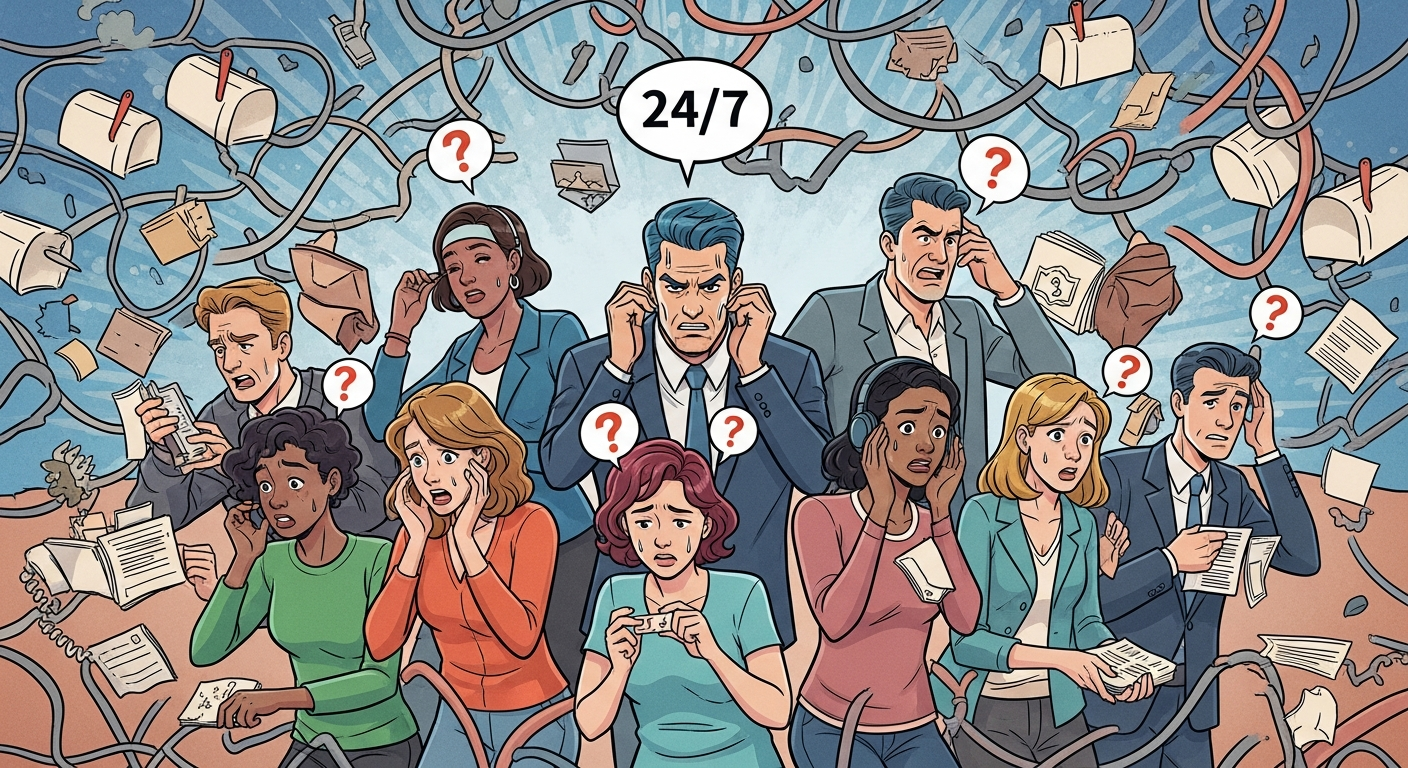
The American consumer has undergone a profound transformation in the last decade. The smartphone era established 24/7 connectivity as the norm rather than the exception. Companies like Amazon and Uber trained consumers to expect immediate responsiveness, transparency, and frictionless experiences. The pandemic only accelerated these trends, as millions of Americans, confined to their homes, came to rely on digital interfaces for their most basic needs.
What has emerged is a customer who no longer distinguishes between business hours and personal time. A homeowner discovering a plumbing issue at 9 p.m. doesn’t mentally file it away for a Monday morning call—they want answers now. This shift has created both challenges and opportunities for service professionals who, unlike tech giants, can’t staff call centers around the clock.
“The reality is that customer experience has become the primary battlefield for business competition,” explains Dr. Elaine Zhao, professor of digital economics at MIT. “Price and even quality are being superseded by the seamlessness of interaction. People will pay more and forgive minor quality issues if a company makes them feel heard and valued at every touchpoint.”
How AI Bridges the Impossible Gap
For home service professionals—plumbers, electricians, landscapers, contractors—the economics of providing 24/7 human support simply don’t compute. Yet these are precisely the businesses where middle-of-the-night emergencies or weekend planning questions frequently arise. This gap between customer expectation and business capability is where AI support systems have found their most natural application.
Modern AI support goes far beyond the rudimentary chatbots of the early 2010s. Today’s systems can understand complex queries, recognize the emotional tenor of communications, access customer-specific information, and provide genuinely helpful responses. They can troubleshoot common problems, schedule appointments, provide estimates, and even process payments—all without human intervention.
Carlos Menendez, who runs a family HVAC business in Arizona, describes the transformation: “We implemented an AI system last year that handles about 80% of our initial customer interactions. It can diagnose common AC issues using a decision tree, show customers how to change filters through augmented reality, and even give ballpark quotes based on home size and system age. Our technicians now arrive already knowing what they’re likely dealing with, and customers feel like we’ve been with them from the moment they realized they had a problem.”
The Human-AI Partnership
The most successful implementations of AI support don’t aim to replace human service professionals but rather to augment and amplify their capabilities. The AI handles the routine, the repetitive, and the after-hours, freeing humans to focus on complex problem-solving, relationship building, and the kind of creative thinking that remains beyond algorithmic reach.
Jennifer Harolds, a landscape designer in Connecticut, uses AI as a first-line consultant for potential clients. “My AI collects information about yard size, sun exposure, soil conditions, and aesthetic preferences before I ever speak to a client. It can show them preliminary designs based on successful past projects. By the time we meet, we’re already three steps into the process, and I can focus on the artistic and personal elements that really require my expertise.”
This partnership extends to business operations as well. AI systems can handle scheduling optimization, inventory management, and even predictive maintenance notifications, allowing service professionals to concentrate on their craft rather than administrative busywork.
The Ethics and Limitations of Automated Support
Despite its transformative potential, AI support is not without complications. Privacy concerns abound, particularly for businesses that operate within people’s homes. There are also questions of algorithmic bias, transparency, and the risk of further digital divides between consumers comfortable with AI interactions and those who are not.
“There’s a real danger in assuming all customers want to interact with AI,” warns consumer advocate Teresa Lundgren. “Older Americans, those with certain disabilities, and people from communities with less technological saturation can feel alienated or even discriminated against when a business pivots too aggressively toward automated support.”
Smart implementation means providing clear paths to human assistance and being transparent about when customers are interacting with AI. It also means recognizing the limitations of current technology. Complex emotional situations, nuanced negotiations, and instances requiring professional judgment still benefit from human touch.
The Future Is Already Unevenly Distributed
William Gibson’s famous observation that “the future is already here—it’s just not evenly distributed” applies perfectly to the adoption of AI support in service businesses. Large companies with substantial technology budgets have moved quickly, while many small and medium-sized businesses remain on the sidelines, concerned about implementation costs, integration challenges, or simply overwhelmed by the pace of change.
Yet democratization is happening rapidly. Turnkey AI solutions specifically designed for particular service industries are proliferating, often requiring little more than a subscription fee and connection to existing business management software. The barriers to entry are falling month by month.
What remains constant is the fundamental shift in customer expectations. The businesses that thrive will be those that recognize AI support not as a futuristic luxury but as a contemporary necessity—a bridge between the limitations of human capacity and the unlimited demands of modern consumers. In this new landscape, 24/7 AI support isn’t merely a competitive advantage; it’s increasingly the price of admission to the marketplace of customer attention.