In 2019, a small family-owned hardware store in Minnesota was preparing to order its seasonal inventory when the owner received a curious email from the inventory management software his son had insisted they adopt. The AI-powered system was recommending they double their order of snow shovels—despite weather forecasts predicting a mild winter. The owner, skeptical but willing to trust the technology, followed the recommendation. When an unexpected series of blizzards hit the region three weeks later, his was the only store in the county with shovels in stock. Sales increased 43% that quarter.
This isn’t just a story about weather prediction. It’s about how artificial intelligence can detect patterns invisible to even the most experienced human intuition—patterns that might determine whether a business thrives or merely survives in our increasingly complex marketplace.
The Invisible Patterns Human Minds Miss
Human cognition, remarkable as it is, comes with built-in limitations. We excel at causal reasoning but struggle with statistical thinking. We’re prone to recency bias, confirmation bias, and dozens of other cognitive shortcuts that served our ancestors well but falter in the face of big data. These limitations aren’t character flaws—they’re features of our neural architecture.
“The human brain is designed to find simple, causal explanations for complex phenomena,” explains Dr. Elena Markov, cognitive scientist at MIT. “We naturally create narratives that make sense of our world, but those narratives often miss the statistical reality underneath.”
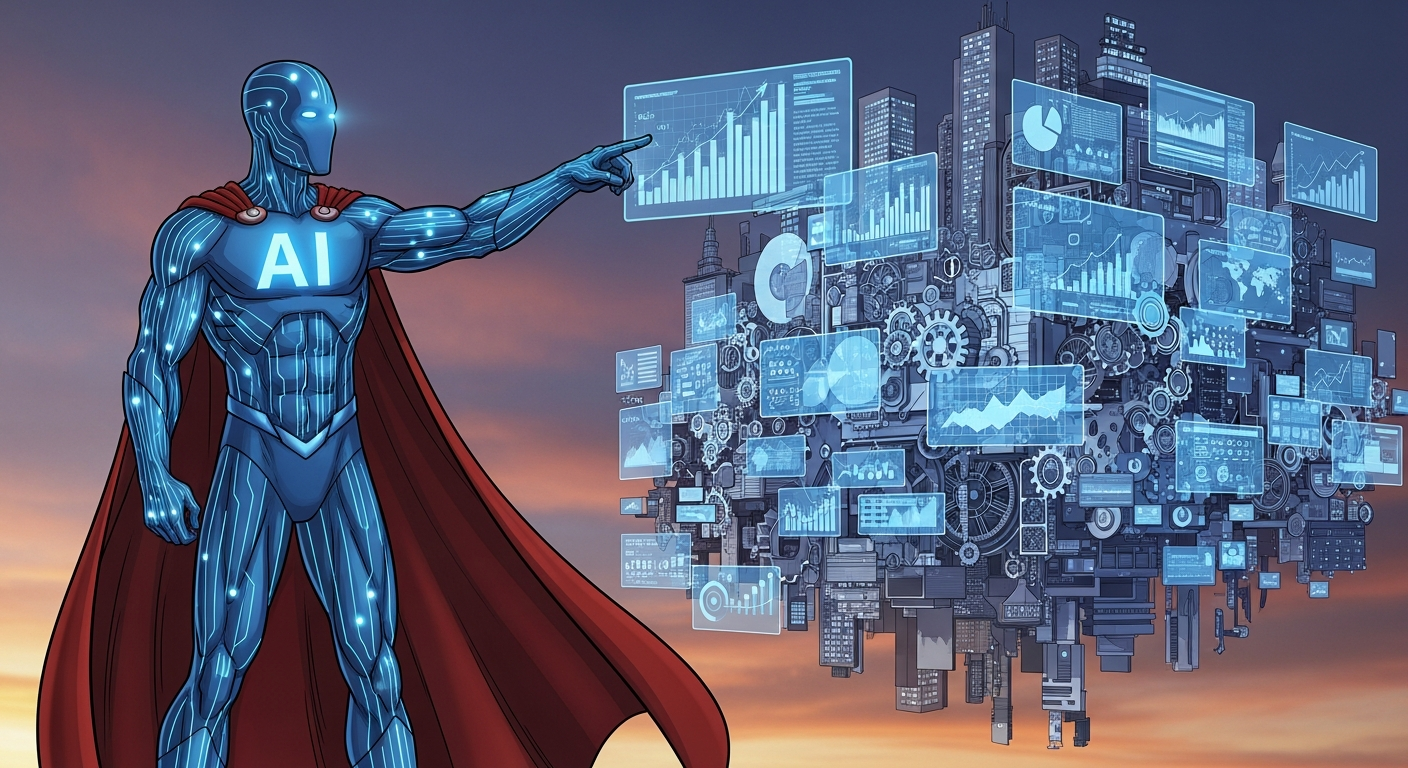
This is where advanced AI systems gain their predictive edge. While small business owners typically rely on experience, intuition, and perhaps spreadsheets to make decisions, AI can simultaneously analyze thousands of variables, detecting subtle correlations that would never occur to even the most astute human observer.
Consider the case of Rivertown Brewery, a craft beer operation that couldn’t understand why sales fluctuated wildly from month to month. Their AI-enhanced analytics platform discovered something counterintuitive: their sales didn’t correlate with local weather (as they had assumed) but with highway construction projects within a 30-mile radius. When certain commuter routes were disrupted, their taproom thrived as drivers sought alternate routes home—knowledge that allowed them to adjust staffing and production schedules accordingly.
Beyond Forecasting: AI’s Predictive Revolution
The most sophisticated AI strategies for small business extend far beyond simple forecasting. Modern systems can predict employee turnover before the employee knows they’re dissatisfied, identify which customers are likely to upgrade their purchases, and even anticipate regulatory changes that might affect specific industries.
“What makes AI prediction truly powerful isn’t just its accuracy but its scope,” says Jamal Washington, founder of Predictive Partners, a consultancy helping small businesses implement AI tools. “It can simultaneously monitor hundreds of variables that might affect your business—from social media sentiment to supply chain disruptions to subtle shifts in consumer behavior—and identify which ones actually matter to your bottom line.”
For Elemental Kitchen, a restaurant supply company with just twelve employees, AI-driven prediction transformed their business model entirely. Their system identified that certain restaurant clients consistently ordered replacement parts just weeks before their equipment failed completely—often causing costly emergency shutdowns. By proactively reaching out to these clients before failures occurred, Elemental not only prevented restaurant closures but transformed from a reactive supplier into a predictive maintenance partner, increasing their average contract value by 78%.
The Human-AI Partnership
Despite these remarkable capabilities, the future of small business isn’t one where AI replaces human judgment but rather one where the two work in concert. The most successful implementations treat AI as a decision support tool rather than an oracle.
“AI gives you probability-based insights, not certainty,” cautions Dr. Markov. “The business owner still needs to interpret those insights through the lens of their experience and knowledge of local conditions.”
This partnership approach is evident at Meridian Consulting, where founder Teresa Chen credits her firm’s growth to the combination of AI-generated client retention predictions and her team’s relationship-building skills. “The AI tells us which clients need attention and why, but it’s our human consultants who make the connection meaningful. The technology identifies the pattern; we provide the solution.”
As AI tools become more accessible and affordable, small businesses are finding themselves with capabilities once reserved for corporate giants. The neighborhood bookstore can now predict which titles will resonate with local readers. The family plumbing business can optimize technician scheduling based on predicted call patterns. The food truck can determine optimal locations based on dozens of variables from weather to local events to traffic patterns.
The Ethical Dimension
This predictive power comes with responsibilities. Small business owners must consider not just what AI can predict, but what it should predict, and how those predictions should be used. Questions of data privacy, algorithmic bias, and transparency aren’t just for tech giants—they’re increasingly relevant to businesses of all sizes.
“The most thoughtful small business owners are developing ethical frameworks for their AI use,” notes Washington. “They’re asking questions like: Are we being transparent with customers about data collection? Are our algorithms reinforcing existing biases? Are we using predictions to manipulate or to better serve?”
As AI continues its march into the business mainstream, the competitive advantage will increasingly belong not to those who simply adopt the technology but to those who integrate it thoughtfully—combining the pattern-recognition power of algorithms with the contextual wisdom and ethical judgment that remain uniquely human. In this partnership lies the future of small business intelligence: seeing patterns invisible to the naked eye while maintaining the human touch that no algorithm can replicate.