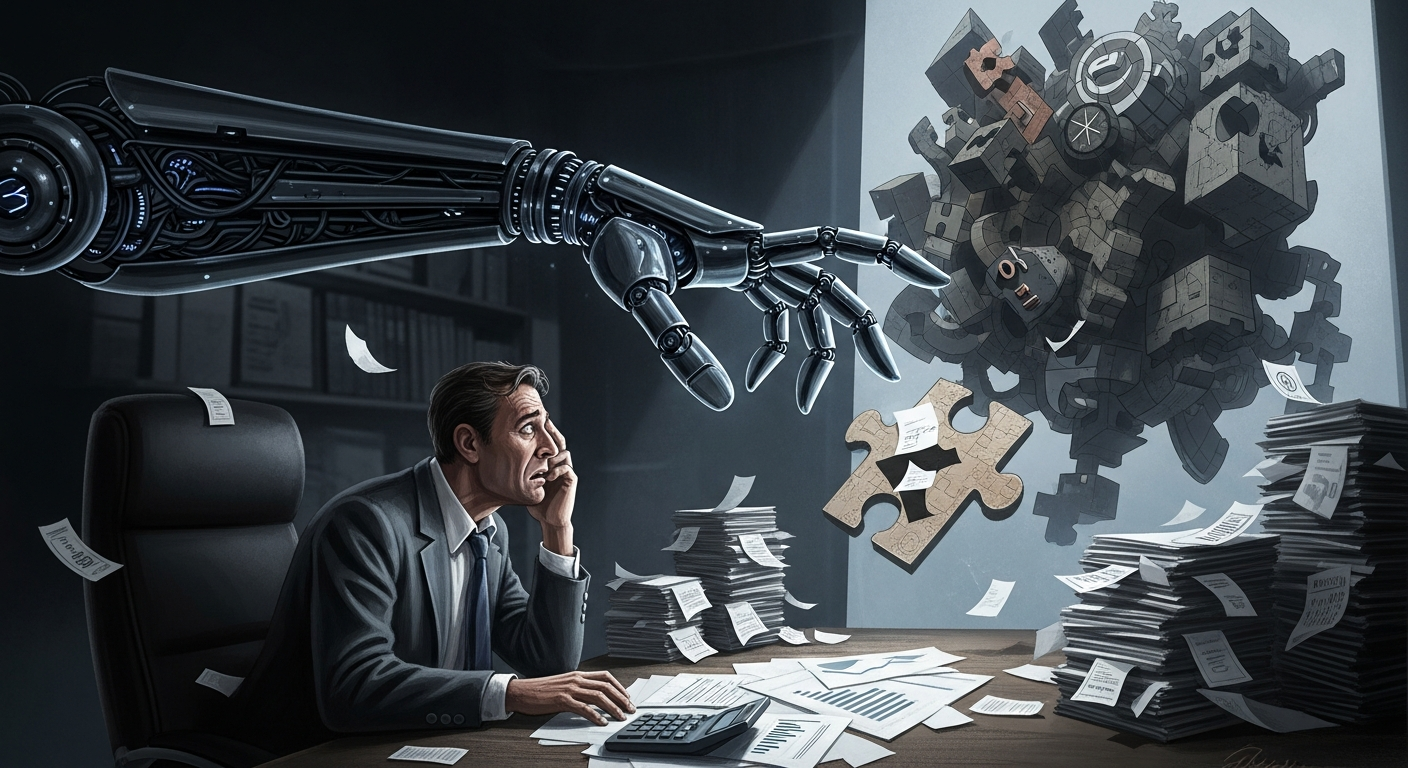
In a cramped office on the outskirts of Minneapolis, Sarah Chen watches her screen as an algorithm analyzes thousands of customer service transcripts in minutes—work that would have taken her team weeks to complete manually. The AI doesn’t just categorize complaints; it identifies emotional patterns, spots emerging issues, and predicts which customers are at risk of leaving. ‘We were hemorrhaging $2.3 million annually from customer churn,’ Chen explains. ‘Within three months of implementing this system, we cut that figure by 62 percent.’ Her small marketing agency isn’t just using artificial intelligence—it’s being transformed by it.
This transformation isn’t isolated. Across America, businesses of all sizes are discovering that their most intractable, expensive problems—the ones they’ve grudgingly accepted as ‘cost of doing business’—may now have solutions powered by advanced AI systems that were either nonexistent or financially out of reach just eighteen months ago.
The Quiet Revolution in Small Business Economics
The narrative around artificial intelligence often centers on dramatic disruptions: autonomous vehicles, medical breakthroughs, or existential risks. But a quieter revolution is unfolding in small businesses across America, where AI is reshaping the fundamental economics of operation. The most expensive problems in business—inefficient processes, human error, customer attrition, inventory management, and knowledge gaps—are precisely the areas where modern AI excels.
‘Small businesses typically lose between 20-30% of potential revenue to inefficiencies that they simply lack the resources to address,’ explains Dr. Elaine Morales, economist at the Small Business Innovation Institute. ‘What’s changed is that AI has democratized access to analytical capabilities once reserved for corporations with eight-figure technology budgets.’
Consider Riverfront Hardware in Dubuque, Iowa. For decades, owner Marcus Jeffries accepted inventory forecasting errors as inevitable—sometimes ordering too much seasonal stock, other times too little. The financial impact was substantial: approximately $87,000 annually in lost sales and obsolete inventory. ‘We implemented an AI forecasting system that cost us $219 per month,’ Jeffries says. ‘It paid for itself within six weeks and has reduced our inventory errors by 78 percent.’
The Psychological Barrier to AI Adoption
Despite compelling economics, many small business owners remain hesitant to embrace AI strategies. This reluctance often stems not from technological limitations but from psychological barriers—what behavioral economists call ‘status quo bias’ and ‘solution aversion.’
‘There’s a profound discomfort with surrendering control to systems we don’t fully understand,’ explains Dr. Talia Washington, who studies technology adoption patterns at Georgetown University. ‘Small business owners in particular tend to trust their intuition and experience over algorithms, even when shown evidence that the algorithms outperform human judgment in specific domains.’
This skepticism isn’t entirely irrational. Early AI implementations often promised more than they delivered. But the current generation of AI tools differs fundamentally from its predecessors. They’re more accessible, requiring minimal technical expertise, and operate as augmentation rather than replacement technologies.
‘The most successful small business AI strategies we’ve documented don’t eliminate human judgment,’ Washington notes. ‘They enhance it by handling routine analytical tasks and surfacing patterns humans might miss, while leaving strategic decisions to people.’
From General to Specific: The Evolution of Business AI
The business AI landscape has evolved rapidly from general-purpose tools to domain-specific solutions addressing particular industry problems. This shift marks a critical inflection point in the technology’s practical utility for small businesses.
Jamal Williams, founder of Precision Plumbing in Atlanta, describes how this evolution changed his perspective. ‘I dismissed AI as Silicon Valley hype until I saw a demonstration of a system specifically designed for service businesses like mine. It analyzed our scheduling patterns, technician routing, and parts inventory simultaneously—something no human dispatcher could do—and identified ways to increase jobs completed per day by 22 percent.’
The system Williams adopted combines several AI approaches: machine learning algorithms that improve with experience, natural language processing for customer communications, and operations research techniques for optimization. But Williams doesn’t need to understand these technical distinctions. ‘I just know it solved our biggest cost center—inefficient scheduling and routing—which was costing us approximately $14,000 monthly.’
This pattern repeats across industries: restaurants using AI to optimize food ordering and reduce waste; law firms employing document analysis systems to review contracts in minutes rather than hours; construction companies utilizing image recognition to identify safety violations before they cause costly accidents.
The Hidden Costs of Inaction
As AI capabilities advance, the competitive disadvantage of non-adoption grows more pronounced. Economists are beginning to quantify this ‘AI gap’ between businesses that leverage these technologies and those that don’t.
‘We’re seeing productivity differentials of 30-45% between comparable businesses based primarily on their implementation of advanced AI strategies,’ says economist Martin Fernandez. ‘What’s particularly striking is how quickly these gaps are widening. This isn’t a gradual divergence—it’s accelerating.’
This acceleration creates a paradoxical situation for small business owners: the longer they wait to implement AI solutions, the further behind they fall, yet the rapidly evolving landscape makes many hesitant to commit to specific technologies. This tension has no easy resolution, but experts suggest starting with clearly defined, measurable problems rather than broad implementations.
‘Identify your single most expensive business problem—the one that consistently drains resources despite your best efforts to solve it,’ advises technology strategist Leila Patel. ‘That’s your AI entry point. Don’t try to transform your entire operation at once.’
As AI continues its march from theoretical possibility to practical necessity, one thing becomes increasingly clear: the question is no longer whether artificial intelligence can solve your most expensive business problems, but whether you can afford to continue operating as if it can’t.