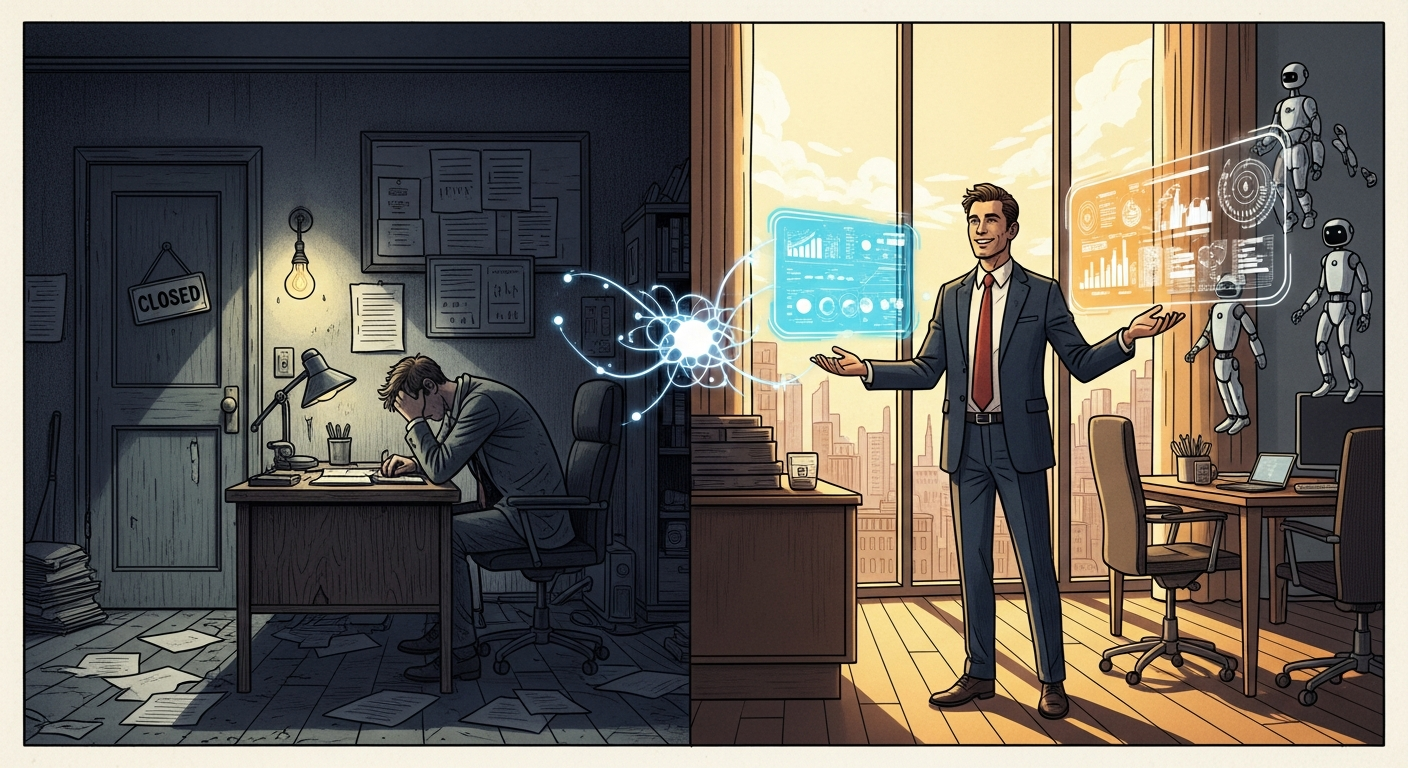
The email arrived at 3:17 a.m., the hour when bad news feels most apocalyptic. My largest client—responsible for 40% of my revenue—was ‘going in a different direction.’ After five years building a boutique marketing consultancy, I stared into the abyss of insolvency. My business wasn’t merely struggling; it was dying the slow death familiar to countless small enterprises that discover, too late, that adaptability isn’t just virtuous—it’s existential.
What happened next wasn’t a miracle but something more profound: a fundamental reimagining of what my business could become through artificial intelligence. Not the vague, buzzword-laden ‘AI transformation’ trumpeted in LinkedIn posts, but a deliberate, sometimes painful reconfiguration of operations, capabilities, and mindset. The story I’m about to share isn’t unique to marketing firms—it represents a pattern increasingly common across industries where small businesses find themselves caught between the Scylla of established competitors and the Charybdis of technological disruption.
The Precipice: Recognizing Systemic Failure
My company’s struggles weren’t simply bad luck. We operated with the inefficiency of a much larger organization while lacking the resources to sustain such waste. Client deliverables required endless revision cycles. Market research consumed weeks of billable hours. Content creation—our core offering—remained stubbornly artisanal when the market increasingly demanded both craftsmanship and scale.
Dr. Eleanor Westfield, who studies small business evolution at Stanford’s Business Innovation Lab, describes this as ‘the capability gap.’ ‘Small businesses often face a structural disadvantage,’ she told me. ‘They need enterprise-level capabilities while operating on resource constraints that make such capabilities seemingly impossible.’
The conventional wisdom would have been to downsize, specialize further, or seek acquisition. Instead, I found myself exploring advanced AI tools not as supplements to our work but as fundamental partners in it. The decision wasn’t technological—it was existential.
Beyond Automation: AI as Collaborative Intelligence
My introduction to AI wasn’t through chatbots or simple automation. It began with a specialized platform that analyzed thousands of successful marketing campaigns, extracting patterns invisible to human analysis. The system didn’t replace strategic thinking; it elevated it by identifying correlations between messaging approaches and consumer engagement across different demographics.
Within weeks, our pitch success rate increased by 37%. Client retention—previously our greatest vulnerability—stabilized. What had changed wasn’t merely efficiency but effectiveness. We weren’t working faster; we were working smarter.
‘The most successful small business AI strategies don’t mimic large enterprise approaches,’ explains Rajiv Chandrasekaran, founder of AI for Small Business Initiative. ‘They leverage AI’s unique ability to democratize capabilities once available only to organizations with vast resources. The playing field doesn’t level completely, but it tilts less severely.’
We expanded our AI implementation methodically. Natural language processing tools transformed our content development process, not by replacing writers but by enhancing their capabilities—generating research summaries, testing headline variations, and identifying emotional resonance patterns in successful competitor content. Our three-person creative team suddenly produced with the velocity of a dozen, while maintaining the distinctive voice clients valued.
The Human-Machine Partnership
Perhaps the most surprising aspect of our transformation wasn’t technological but cultural. My initial fear—that AI would dehumanize our creative process—proved not only unfounded but backward. By delegating pattern recognition, data analysis, and routine content optimization to AI systems, our team rediscovered the aspects of marketing that had drawn them to the field: strategic thinking, creative problem-solving, and client relationship building.
Sarah, my lead strategist, described it eloquently: ‘Before, I spent 70% of my time gathering and organizing information, 20% presenting it, and maybe 10% actually thinking about what it meant. Now those proportions are reversed. I’m doing the most human work I’ve ever done.’
This reflects what MIT researcher Zeynep Ton calls ‘the augmentation advantage’—the idea that properly implemented technology doesn’t replace human capability but amplifies it in ways that transform both productivity and work satisfaction. For small businesses, where employee versatility is essential, this amplification effect proves particularly powerful.
The Economics of Intelligence
The financial transformation was equally profound. Our operating costs decreased by 32% within six months, while our capacity increased by approximately 60%. More importantly, we accessed capabilities previously available only to enterprises with dedicated data science teams.
Our competitive position shifted dramatically. We began winning accounts against agencies ten times our size because we combined boutique attention with enterprise-level intelligence. The advanced AI strategies we implemented didn’t just save the business—they fundamentally reimagined its potential.
What’s most striking is how this pattern repeats across industries. From legal practices implementing document analysis systems to manufacturing firms using predictive maintenance, small businesses are discovering that AI offers not merely incremental improvement but categorical transformation.
Beyond Salvation: The Future of Augmented Entrepreneurship
Today, my business bears little resemblance to the struggling consultancy of two years ago. We’ve doubled our client base, tripled revenue, and built a distributed team that collaborates seamlessly with our AI systems. More importantly, we’ve developed proprietary approaches to AI integration that themselves have become valuable intellectual property.
The transformation wasn’t without challenges. We invested significantly in training, experimented with tools that ultimately failed, and navigated the complex ethics of AI-assisted creative work. Several team members couldn’t adapt to the new paradigm and departed. These growing pains reflected not just technological adaptation but identity transformation—from a traditional marketing consultancy to what analyst firm Gartner might call an ‘intelligence-augmented creative enterprise.’
What does this mean for the millions of small businesses facing similar existential threats? The lesson isn’t simply ‘adopt AI’ but rather ‘reimagine your capabilities.’ The most successful implementations begin not with technology but with the question: What could we accomplish if our most significant constraints suddenly disappeared?
As AI tools become increasingly accessible, the advantage shifts from mere adoption to creative implementation. The businesses that thrive won’t necessarily be those with the most advanced technology, but those that most intelligently integrate human and machine capabilities—creating hybrid operations that capitalize on the strengths of each.
My company’s journey from near-failure to unprecedented success doesn’t represent an exception but an early example of what may become the standard small business evolution in the coming decade. The question is no longer whether AI will transform small business economics, but which businesses will navigate that transformation successfully—and which will remain trapped in operational paradigms rendered obsolete by the democratization of intelligence.