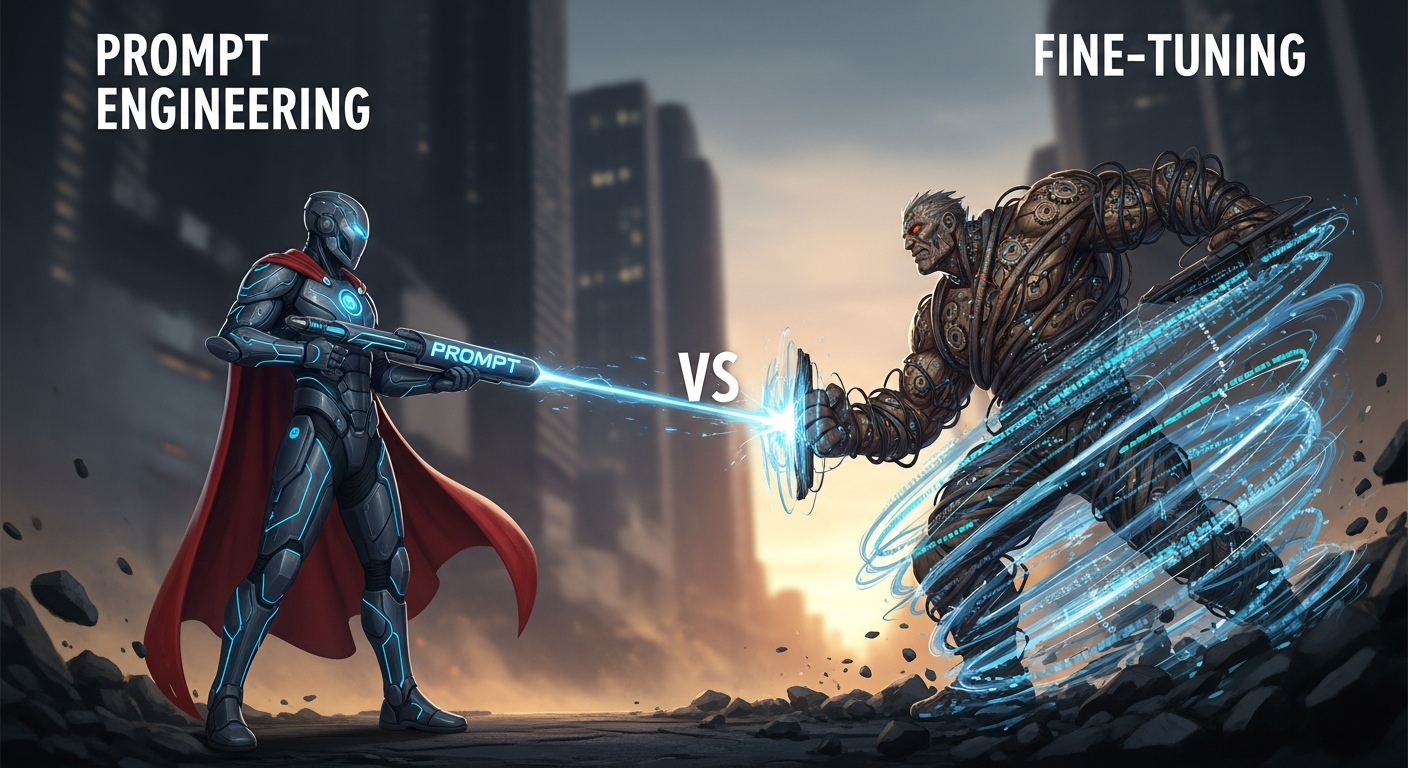
In a basement office at Stanford University, a researcher types a carefully worded prompt into an AI interface: ‘Explain quantum entanglement as if I’m a high school student.’ Across campus, another researcher uploads gigabytes of physics textbooks to fine-tune a language model specifically for scientific explanations. Both seek the same outcome—an AI that can demystify complex physics—but their methodologies couldn’t be more different. This dichotomy represents one of the most consequential strategic decisions in applied artificial intelligence today: whether to master the art of prompt engineering or invest in the technical complexity of fine-tuning models.
The Quiet Revolution in AI Interaction
Prompt engineering—the craft of constructing precise textual instructions that elicit desired behaviors from AI systems—has emerged as an unexpected power center in artificial intelligence. It requires no code, no specialized hardware, and minimal technical expertise. Yet in the hands of skilled practitioners, it can transform general-purpose AI systems into specialized tools with remarkable capabilities.
Dr. Melanie Mitchell, computer scientist and AI researcher at the Santa Fe Institute, describes the phenomenon as ‘linguistic programming.’ ‘We’re witnessing the development of an entirely new discipline,’ she explains. ‘People are essentially programming these systems through natural language rather than code. It’s democratizing AI in ways we never anticipated.’
This democratization has profound implications. A historian with no technical background can now coax an AI to analyze primary sources in the style of different scholarly traditions. A teacher can engineer prompts that generate age-appropriate explanations of complex topics. These capabilities were unimaginable just three years ago.
The limitations, however, become apparent at the boundaries of the model’s training. When faced with specialized domains or tasks requiring consistent performance, prompt engineering begins to falter. The model’s underlying knowledge and capabilities remain fixed—you’re simply learning to navigate what’s already there, not expanding its fundamental abilities.
The Technical Depth of Fine-Tuning
Fine-tuning represents the other end of the spectrum—a technically demanding approach that involves additional training of pre-trained AI models on specialized datasets. This process modifies the model’s internal weights and parameters, essentially teaching it new capabilities rather than merely instructing it how to use existing ones.
At Anthropic, research scientist Jared Kaplan leads teams that fine-tune large language models for specific applications. ‘Fine-tuning allows us to embed new knowledge and capabilities directly into the model’s parameters,’ he notes. ‘The difference is like comparing someone who’s memorized clever ways to ask questions versus someone who’s actually studied the subject matter deeply.’
This approach requires significant computational resources, technical expertise, and often proprietary access to model weights. It’s expensive, time-consuming, and typically reserved for organizations with substantial AI infrastructure. But the results can be transformative—models that consistently outperform prompt-engineered solutions in specialized domains.
Healthcare provides a compelling example. Researchers at Mass General Brigham fine-tuned language models on anonymized medical records and literature, creating systems that could assist with diagnosis in specialized fields. No amount of prompt engineering could match the performance of these domain-adapted models.
The Decision Framework: When Each Approach Wins
The choice between prompt engineering and fine-tuning isn’t binary but exists on a spectrum dictated by resources, expertise, and objectives. Several factors influence which approach delivers superior results in specific contexts.
When time and accessibility are paramount, prompt engineering clearly prevails. ‘For rapid prototyping or exploratory applications, prompt engineering offers unmatched flexibility,’ says Lily Peng, who leads healthcare AI initiatives at Google. ‘You can iterate in minutes rather than days or weeks.’ This agility makes prompt engineering ideal for testing concepts, exploring AI capabilities, and deploying solutions with minimal infrastructure.
Conversely, when consistency, safety, and specialized knowledge are non-negotiable, fine-tuning becomes essential. Financial services firm Bloomberg has invested heavily in fine-tuning models for financial analysis, creating systems that understand market terminology and regulatory contexts far better than any prompted general-purpose AI.
The scale of deployment also matters. For individual or small-team applications, prompt engineering offers a remarkably low barrier to entry. For enterprise-scale solutions serving millions of users, the investment in fine-tuning often pays dividends through improved performance and reduced operational complexity.
The Convergence on the Horizon
The distinction between these approaches is already beginning to blur. Emerging techniques like parameter-efficient fine-tuning (PEFT) and prompt tuning—which adjusts only a small subset of a model’s parameters—offer middle paths that combine elements of both approaches. Companies like Hugging Face are developing tools that make lightweight fine-tuning accessible to non-specialists.
Perhaps most intriguingly, some researchers are now fine-tuning models specifically to be better at following prompts—a meta-approach that suggests these methodologies may ultimately be complementary rather than competitive.
As AI capabilities continue to evolve, the question may shift from which approach is superior to how they can be strategically combined. The organizations and individuals who master this integration—understanding when to prompt, when to tune, and when to do both—will likely define the next frontier of artificial intelligence applications.
In that Stanford basement, the researcher has moved beyond choosing between approaches. She now fine-tunes models to respond better to certain prompt structures, then crafts meticulous prompts to extract the best performance from her fine-tuned system. The future belongs not to those who choose sides in this methodological divide, but to those who build bridges across it.