AI infrastructure you actually own.
The stack beneath every serious enterprise AI system — open-source LLMs, on-prem inference, GPU strategy, and inference management. We build it inside your environment so your data, your models, and your unit economics stay under your control.
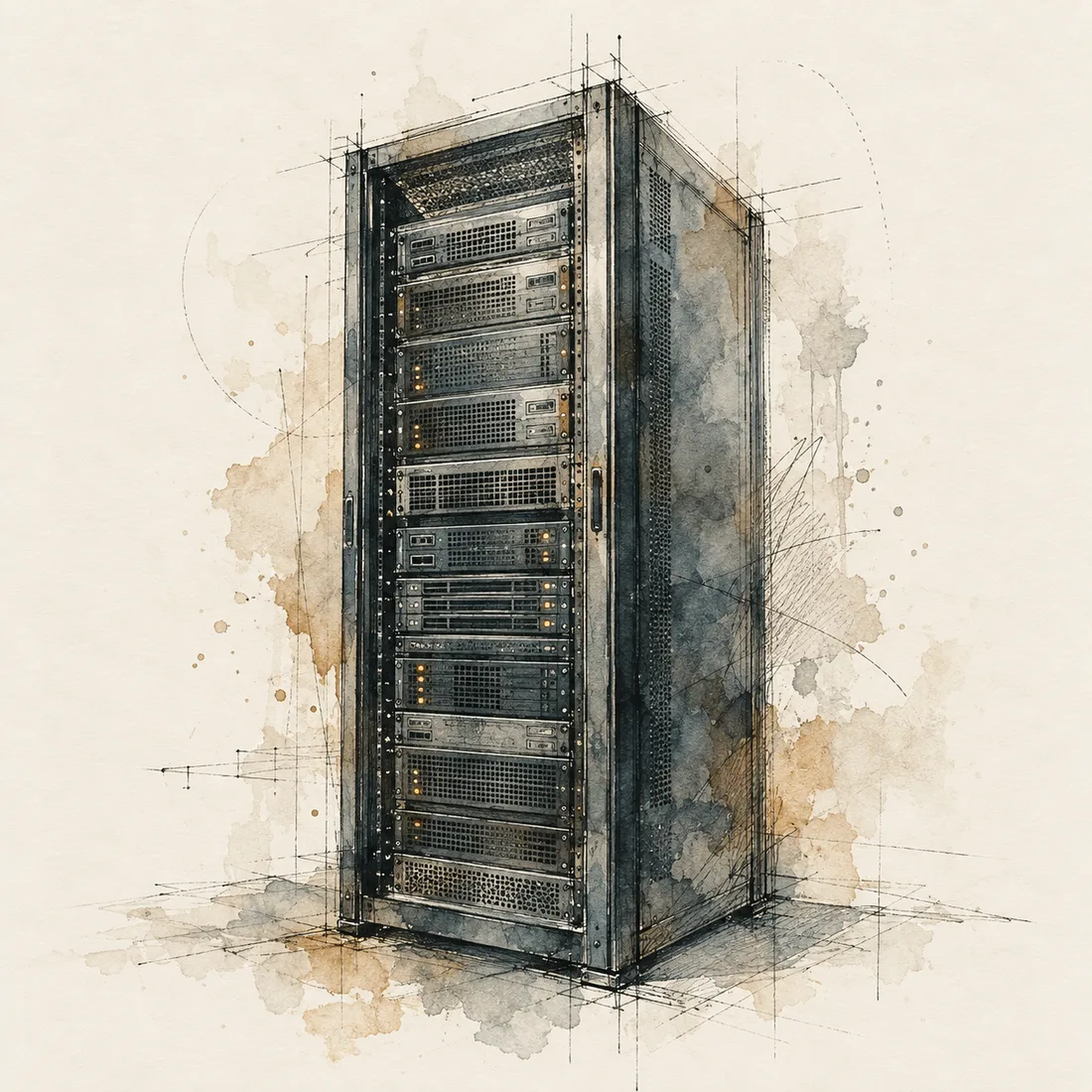
The infrastructure decision is the one that compounds
It is easy to ship a demo on a hosted API. It is much harder to run AI in production at enterprise scale, on regulated data, without watching your bill or your latency spiral — and without handing your most sensitive content to a third party. That is an infrastructure problem, and it is the one most teams discover too late.
We build the layer underneath the product: the open-source models, the serving stack, and the compute they run on. Brought to the data instead of the other way around, deployed on-premise, in your VPC, or air-gapped, and engineered so the cost per answer is a number you set rather than a number you fear.
Four layers of production AI infrastructure.
Each is a discipline in its own right. We build them as one coherent stack, or slot into the layer you need.
- Model selection & eval
- Fine-tuning & distillation
- Self-hosted serving
- On-prem & air-gapped
- Zero data egress
- Data sovereignty
- Sizing & capacity planning
- On-prem vs cloud economics
- Utilization engineering
- Throughput & latency tuning
- Quantization & batching
- Cost-per-token observability
- Audit + observability
- Access control
- HIPAA / SOX / GDPR-aware
Why enterprises bring the infrastructure in-house
The move from a hosted API to owned infrastructure usually comes down to four pressures that a credit-card key cannot solve:
- Data can't leave — regulated, classified, or contractually protected data has to stay inside your boundary, which means the model comes to it.
- The bill is unpredictable — at sustained volume, per-token API pricing dwarfs the cost of running open-source models on compute you control.
- Lock-in is a risk — a single vendor controlling your model, your pricing, and your roadmap is an operational and strategic exposure.
- Performance has to be guaranteed — latency and throughput SLAs are far easier to hold on infrastructure you own and tune than on a shared endpoint.
From scope to production.
Fixed scope, fixed price, twelve weeks from briefing to live deployment.
Common questions.
What is private AI infrastructure?
Private AI infrastructure is the full stack needed to run AI inside your own environment — model serving, retrieval, vector storage, and GPU compute — rather than calling a third-party API. It lets you self-host open-source LLMs, keep data inside your network, and control cost and performance directly.
Should we self-host LLMs or use a hosted API?
It depends on data sensitivity, volume, and unit economics. Regulated data that cannot leave your environment, high sustained token volume, or strict latency requirements usually favor self-hosting open-source models on infrastructure you control. We model both paths against your workload before recommending one.
Do you build on-premise as well as in our cloud?
Yes. We deploy on-premise, in air-gapped environments, and inside your own cloud tenant (VPC). The architecture is the same — the model and retrieval run where your data already lives, so nothing has to leave the boundary you control.
Explore related capabilities.
Ready to own your stack?
Thirty minute executive briefing. Bring your workload, your data boundary, and your volume, and you leave with a clear architecture and a cost model for self-hosting versus hosted. Response inside 24 hours.
Experienced within






Markets served.
As an enterprise AI agency, eeko systems delivers production AI systems remote-first across the United States and internationally — including these markets: